
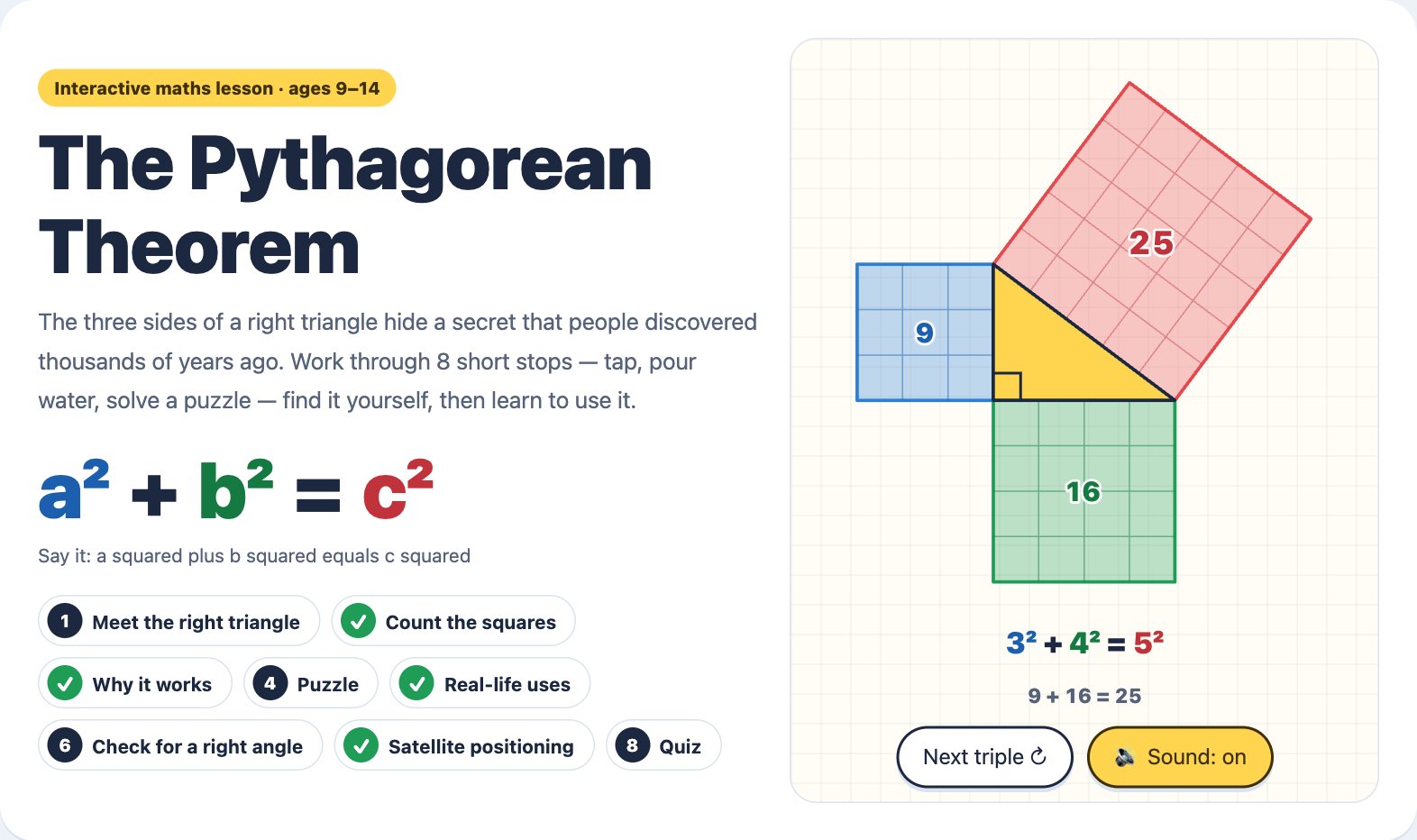
The Pythagorean Theorem Interactive Lesson is a free web page with no sign-in for children aged 9 to 14. It teaches a² + b² = c² in eight stops: spotting the hypotenuse, counting squares and a water-pouring experiment, a proof by sliding four triangles, a Perigal dissection puzzle, a calculator with ladder and shortcut problems, the converse for checking right angles, a 3D simulation of how satellites locate a car, and an eight-question quiz that changes every round. It comes in six languages.
The page is here: Pythagorean Theorem Interactive Lesson. It is free, needs no sign-in, works in phone and desktop browsers, and comes in six languages: English, Simplified and Traditional Chinese, Japanese, Korean and Portuguese. It is split into eight short stops, from spotting the hypotenuse to a final quiz. Below is what each stop does and why it comes where it does.
1. Why a memorised formula still goes wrong
Watching my child, two mistakes came up again and again. The first was picking the wrong hypotenuse: in the textbook the right angle always sits in the bottom-left corner, so once a question turns the triangle, the bottom side gets taken for the hypotenuse. The second was adding when looking for a leg: with a hypotenuse of 13 and a leg of 5, the answer came out as 13 + 5 or 13 − 5.
Both mistakes have the same root. To the child, a² is just a symbol, not an area. So every stop on the page does the same job: it turns the formula back into something you can see and move.
2. Stop 1: get the hypotenuse right first
The triangle on the page turns and flips at random, and the child taps the side they think is the hypotenuse. Three right answers in a row finish the stop. A wrong tap costs nothing; it just says that side touches the right angle, so it is a leg.
The only rule I gave was this: find the little square first, and the hypotenuse is straight across from it. After a few rounds the triangle could face any way and the answer was still right.
3. Stop 2: count the squares, then pour the water
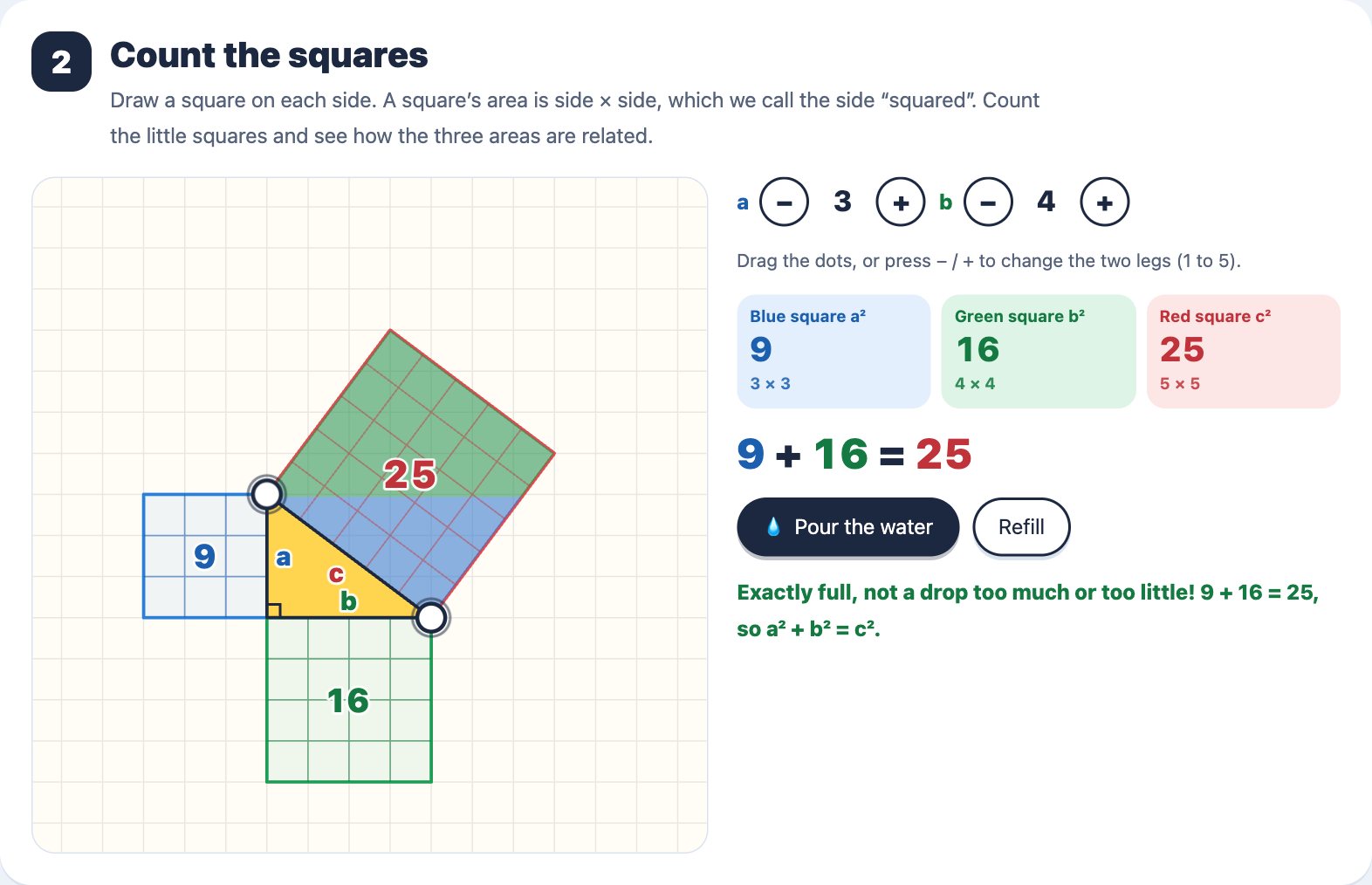
Each side carries a square with a grid drawn on it. Dragging the dots changes the two legs, from 1 to 5. With legs 3 and 4, the blue square has 9 cells and the green one 16, and the red square has exactly 25.
Press the water button and the blue and green squares, full of water, pour into the red square one after the other and fill it exactly. The water level is worked out from the area, not played from a fixed animation, so it stays correct for any side lengths.
The case I most wanted my child to see was legs 1 and 2. The hypotenuse is not a whole number and the grid in the red square no longer lines up, yet the water still fills it exactly. The theorem is about area; it is not something that only works for 3, 4 and 5.
4. Stop 3: why it works for every right triangle
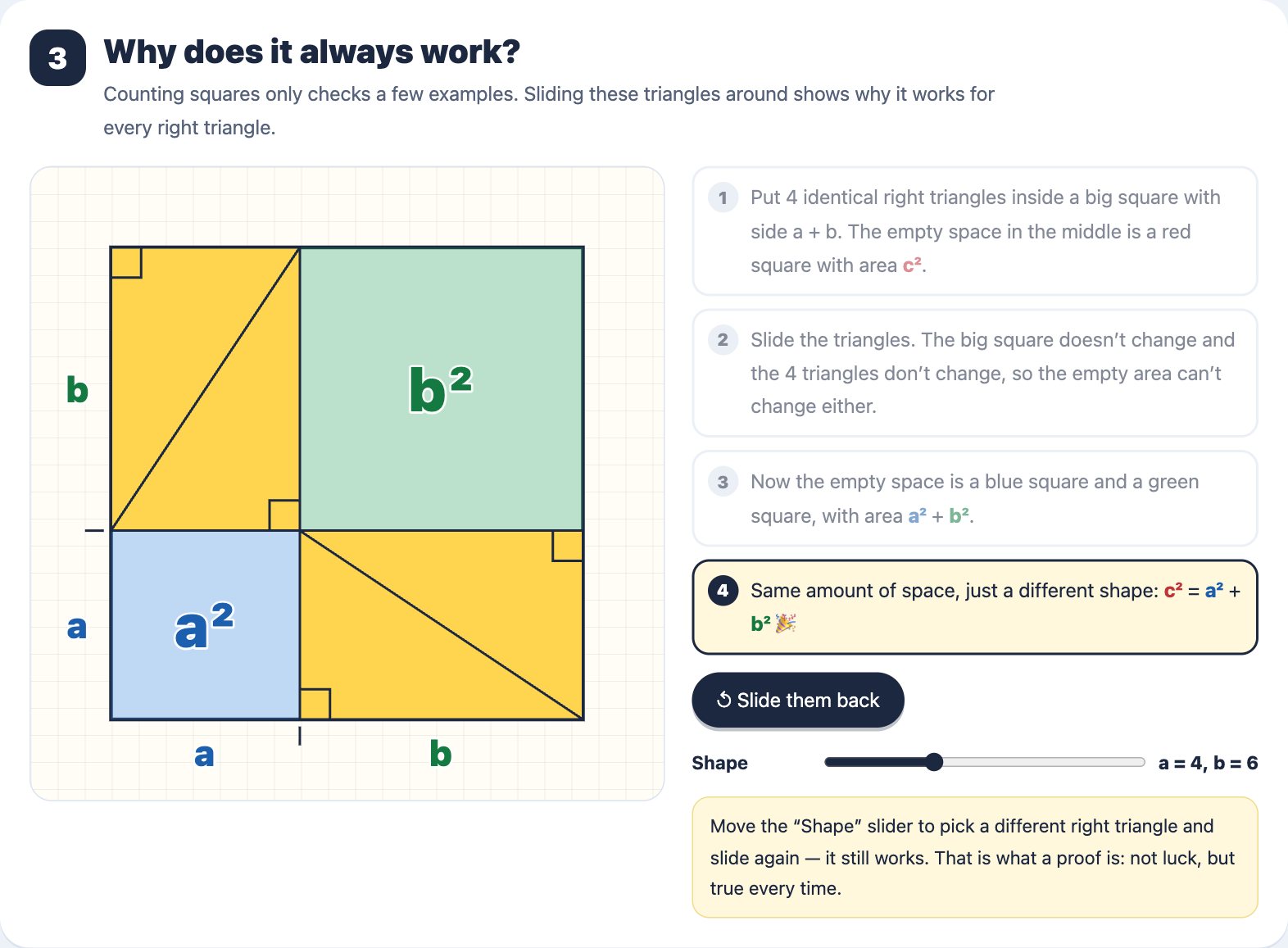
My child asked whether counting squares wasn’t enough. My answer was that counting only checks a few examples; to show it holds for every right triangle you need a different argument. The page slides triangles around:
- Put four identical right triangles inside a big square with side a + b. The space left in the middle is a square of area c².
- Slide the triangles. The big square doesn’t change and neither do the four triangles, so the empty area can’t change either.
- After the move, the empty space is two squares with total area a² + b².
- It is the same empty space in a new shape, so c² = a² + b².
Moving the Shape slider gives a different triangle; slide again and it still works. This is where the difference between an example and a proof first clicked for my child.
5. Stop 4: build it once with your own hands
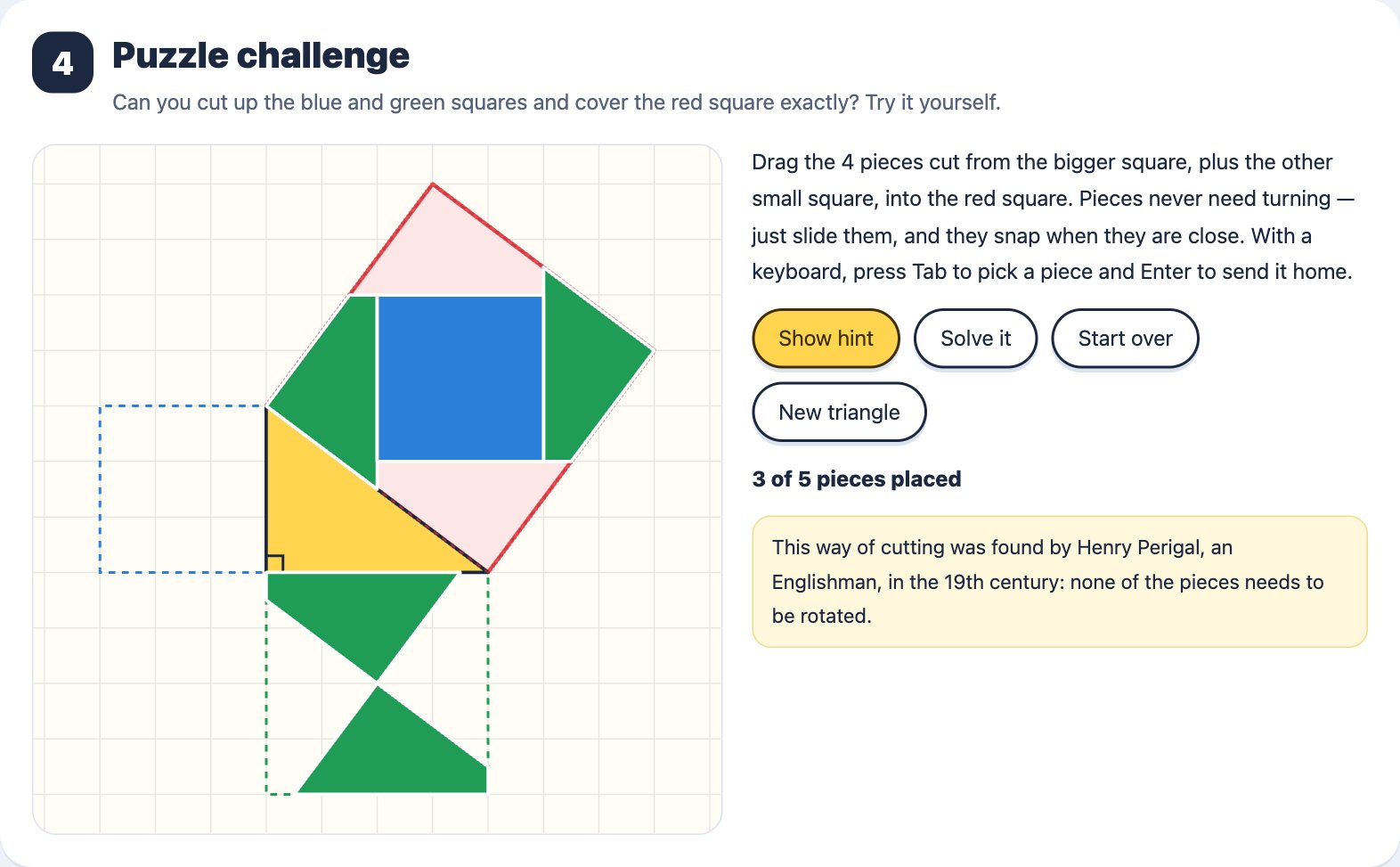
The larger leg square is cut into four pieces. Together with the other small square, they are dragged into the red square on the hypotenuse. Every piece only slides, never turns, and snaps into place when it gets close. This way of cutting was found by the Englishman Henry Perigal in the 19th century.
There are five triangle shapes to choose from. I checked every one by scattering random points with a script: the pieces always cover the square exactly, with no overlaps and no gaps. If a child gets stuck, the hint shows dotted outlines, and a solve button plays it through. Building it once sticks better than watching an animation ten times.
6. Stops 5 and 6: use it, then use it backwards
Once it makes sense, it should get used. These two stops hold four small tools:
| Tool | What it works out | The formula behind it |
|---|---|---|
| Pythagoras calculator | The third side from any two, with every step written out | c = √(a² + b²), b = √(c² − a²) |
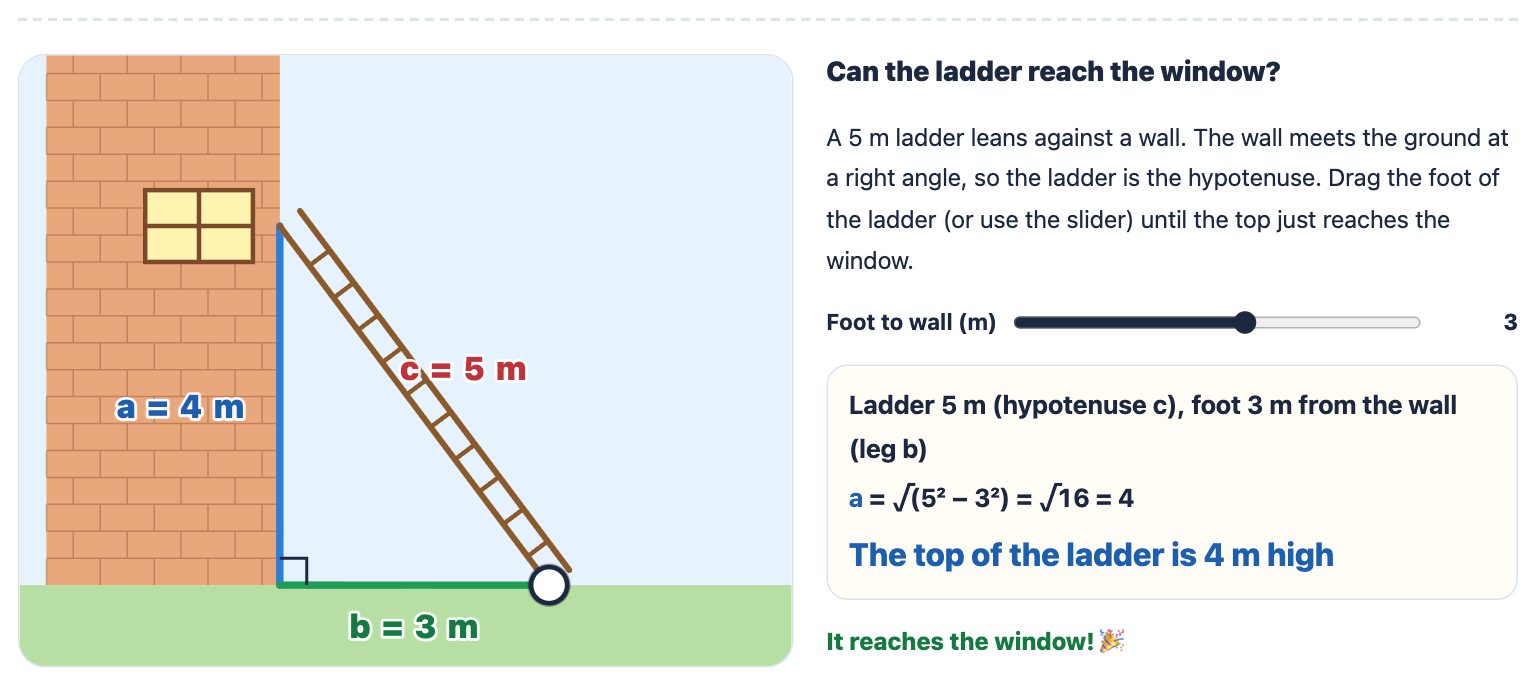
| Can the ladder reach the window? | How far from the wall a 5 m ladder must stand to just reach the window | a = √(5² − b²) |
| Road or park? | A race across a 400 m × 300 m park: how much shorter the diagonal path is | √(400² + 300²) = 500, so 200 m shorter |
| Check for a right angle | Whether any three sides make a right triangle | Compare a² + b² with c² |
Stop 6 is the converse: if three sides fit a² + b² = c², the triangle must have a right angle. If a² + b² is bigger than c², the triangle is acute; if it is smaller, the triangle is obtuse. The page also has a knotted rope that, pulled into a triangle of 3, 4 and 5 parts, makes a right angle. Ancient Egyptians are said to have made right angles this way, and builders still measure 3, 4 and 5 to check a corner.
With a hypotenuse of 13 and a leg of 5, the other leg is √(13² − 5²) = √(169 − 25) = √144 = 12. It is not 13 − 5 = 8, and not 13 + 5. The calculator’s find-a-leg mode writes this step out; trying a few pairs of numbers is enough to make it stick.
7. Stop 7: how satellites find a car
My child once asked how the satnav knows where we are. This stop answers with a 3D model you can turn around, and the maths is the Pythagorean theorem again.
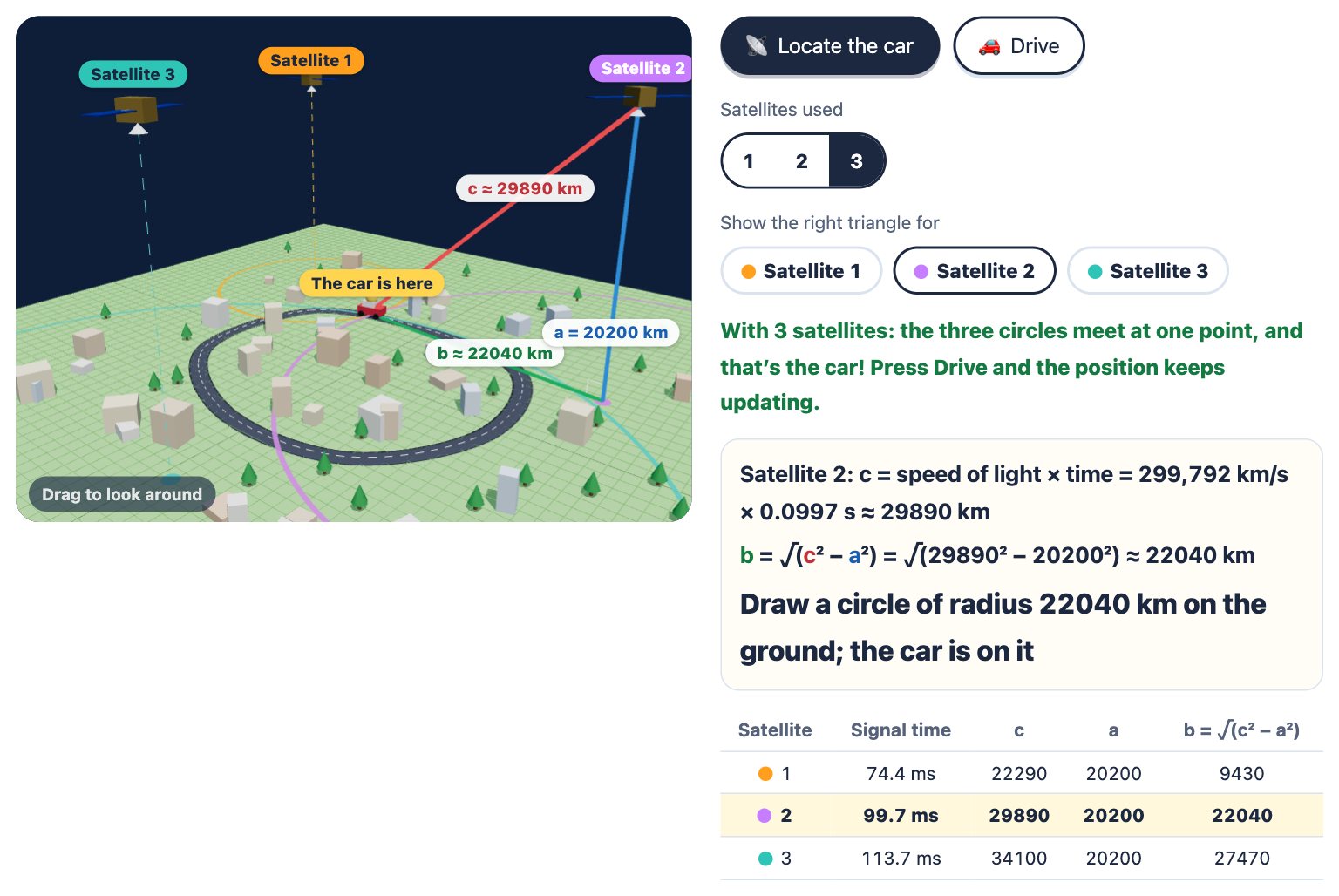
- Each satellite keeps sending signals stamped with the time. The car works out how long a signal took and multiplies by the speed of light (about 300,000 km per second): that is its distance c to the satellite.
- The satellite’s height a is known. A line straight down from the satellite, then across the ground to the car, makes a right triangle, so the distance along the ground is b = √(c² − a²).
- A circle on the ground with radius b, centred on the point under the satellite, must pass through the car.
The page lets you use 1, 2 or 3 satellites. With one, the car is somewhere on a circle; two circles cross at two points; three circles meet at only one point, and that is the car. Press Drive and the car moves along the road while the circles and the pin follow it. A table lists each satellite’s signal time, c, a and b. For example, a signal taking 99.7 milliseconds means a distance of about 29,890 km; with the satellite 20,200 km up, Pythagoras gives about 22,040 km along the ground.
To keep the right triangle easy to see, the ground is flat and the satellites and car are drawn huge. Real GPS satellites orbit about 20,200 km up and the Earth is round; a car’s clock is not precise enough, so in practice at least 4 satellites are needed, the extra one to correct the time.
8. Stop 8: an eight-question quiz
The questions cover five kinds: finding the hypotenuse, finding a leg, square areas, deciding whether a triangle is right-angled, and a ladder height. Every round brings new numbers. The wrong options include the usual mistakes on purpose, such as adding the two legs or subtracting a leg from the hypotenuse. Each answer shows the working straight away, and the final score earns zero to three stars.
Finished stops get a tick at the top of the page. Progress stays in the current browser, with no account needed.
9. How we used it: three days, fifteen minutes a day
- Day one: stops 1 to 4, with the focus on the water and the sliding triangles, until the child can explain why it works.
- Day two: stops 5 to 7, then measure things at home. Measure the length and width of a desk, work out the diagonal, then check it with a tape measure.
- Day three: the quiz only; any wrong answer sends the child back to the matching stop.
The desk was the best part. The worked-out diagonal and the tape measure differed by a few millimetres, and that was when the formula started to feel genuinely useful.
The language switch is at the top of the page. The Traditional Chinese version uses the name common in Taiwan, 畢氏定理, and metres written as 公尺; the Japanese version uses 三平方の定理, the name in Japanese textbooks; the Portuguese version writes decimals with a comma. To go on to sin, cos and tan, see the right triangle explorer, where dragging a vertex changes all six trig ratios at once.
Frequently asked questions
What is the easiest way to explain the Pythagorean theorem to a child?
Start by making a² an area: draw a square on each side, count the cells or pour water, and let the child see the two small squares fill the big one exactly. Then slide four triangles around to show why it holds for every right triangle, and finish with real problems like ladders and shortcuts.
Is the Pythagorean theorem page free? Does it need an account?
It is free and needs no sign-in, in phone or desktop browsers, in English, Simplified and Traditional Chinese, Japanese, Korean and Portuguese. Finished stops and the sound setting are saved only in the current browser.
Is there a proof of the Pythagorean theorem a child can follow?
Yes. Put four identical right triangles in a big square with side a + b and the empty space is c². Slide the triangles and the empty space becomes two squares, a² and b². The big square and the triangles never changed, so c² = a² + b².
Why do you subtract when finding a missing leg?
Because c² = a² + b², so b² = c² − a², then take the square root. With a hypotenuse of 13 and a leg of 5: 169 − 25 = 144, so the other leg is 12. Working out 13 − 5 = 8 is wrong; you subtract the squares, not the sides.