
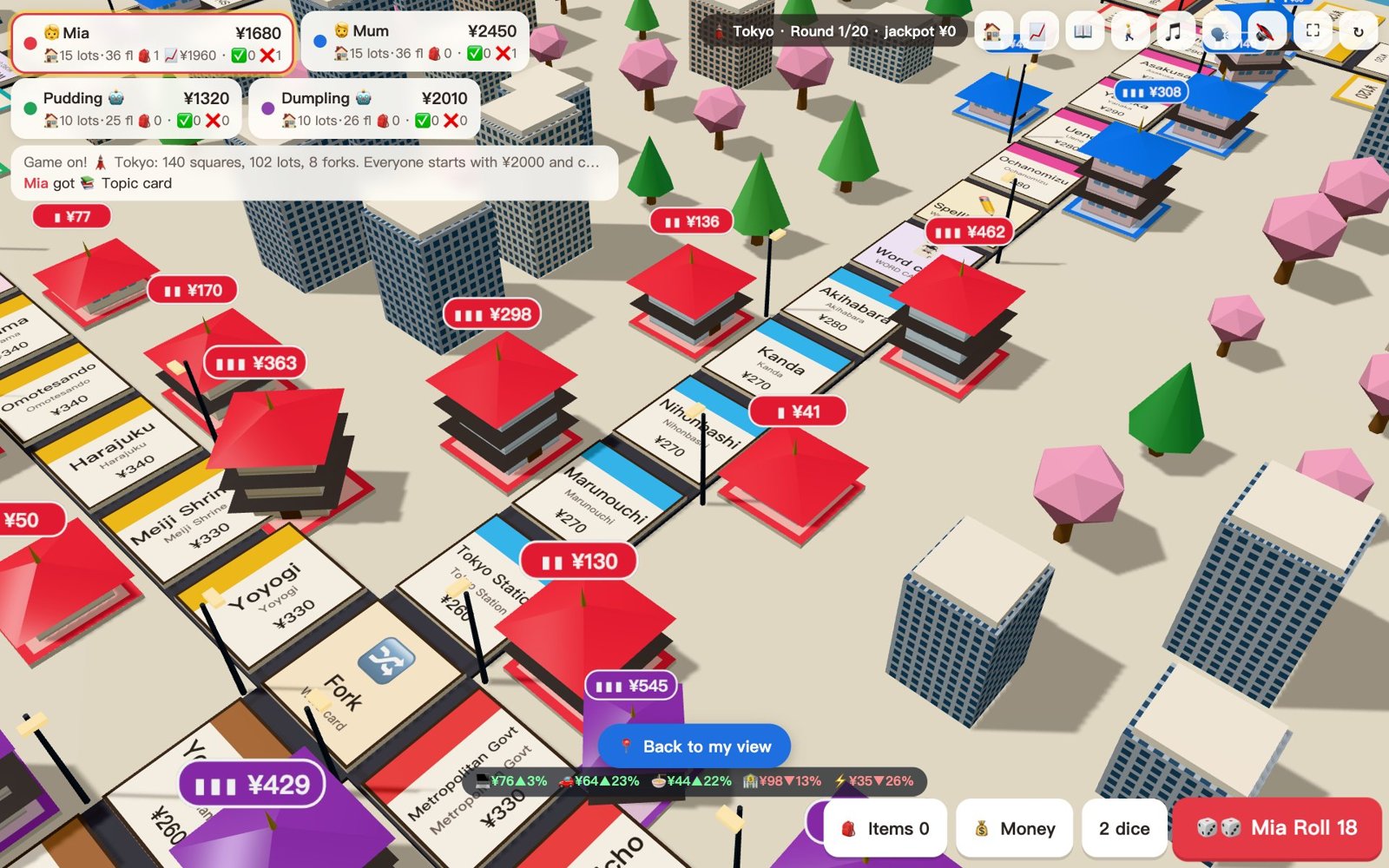
Word Tycoon 3D is a free 3D English board game in GachaLex that runs in the browser: four city maps (New York, London, Tokyo, Shanghai), buy land, build and collect rent, and answer English questions on event squares. Each player picks an age band (6-8, 9-12, 13-17, 18+) that sets word length, English maths problems and answer time; popups can be read aloud and wrong answers come back. It also has stocks, loans, property news and 14 item cards, supports 7 languages, and 2 to 4 players can play online.
The game is here: Word Tycoon 3D, or open it from the GachaLex Game House. It is free to play and needs a GachaLex account, which is also free. It runs in phone, tablet and computer browsers, with nothing to download.
1. How it plays
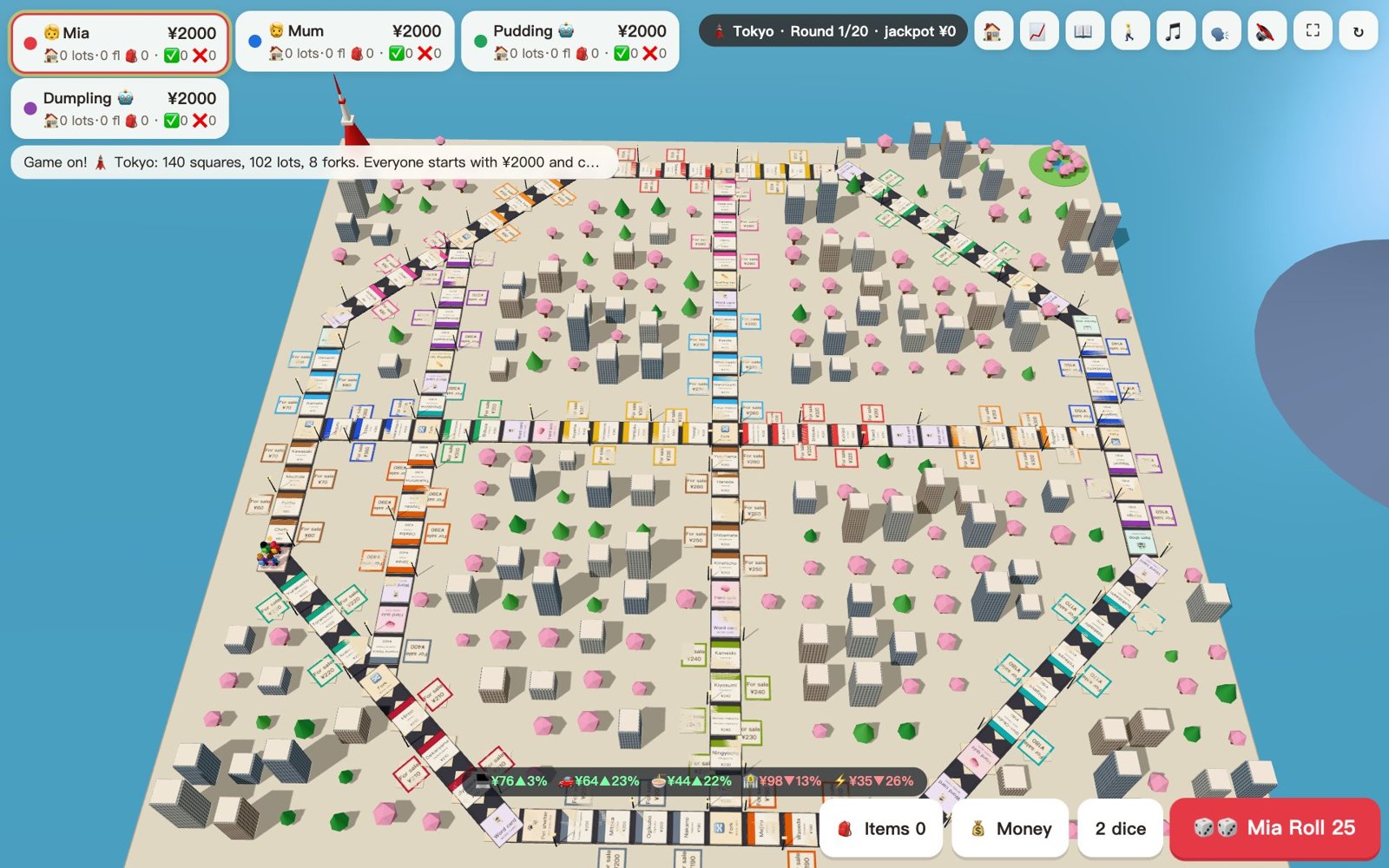
The basics follow Monopoly: everyone starts with 2,000 and collects 200 for passing Start. Land on an empty lot to buy it, build on your own lots up to 3 floors, and rent stacks up floor by floor. Own a whole street and rent is multiplied by 1.5; when lots sit next to each other, landing on one means paying for the whole connected row. That is why the maps have many long straight streets, each with up to 5 lots of one colour.
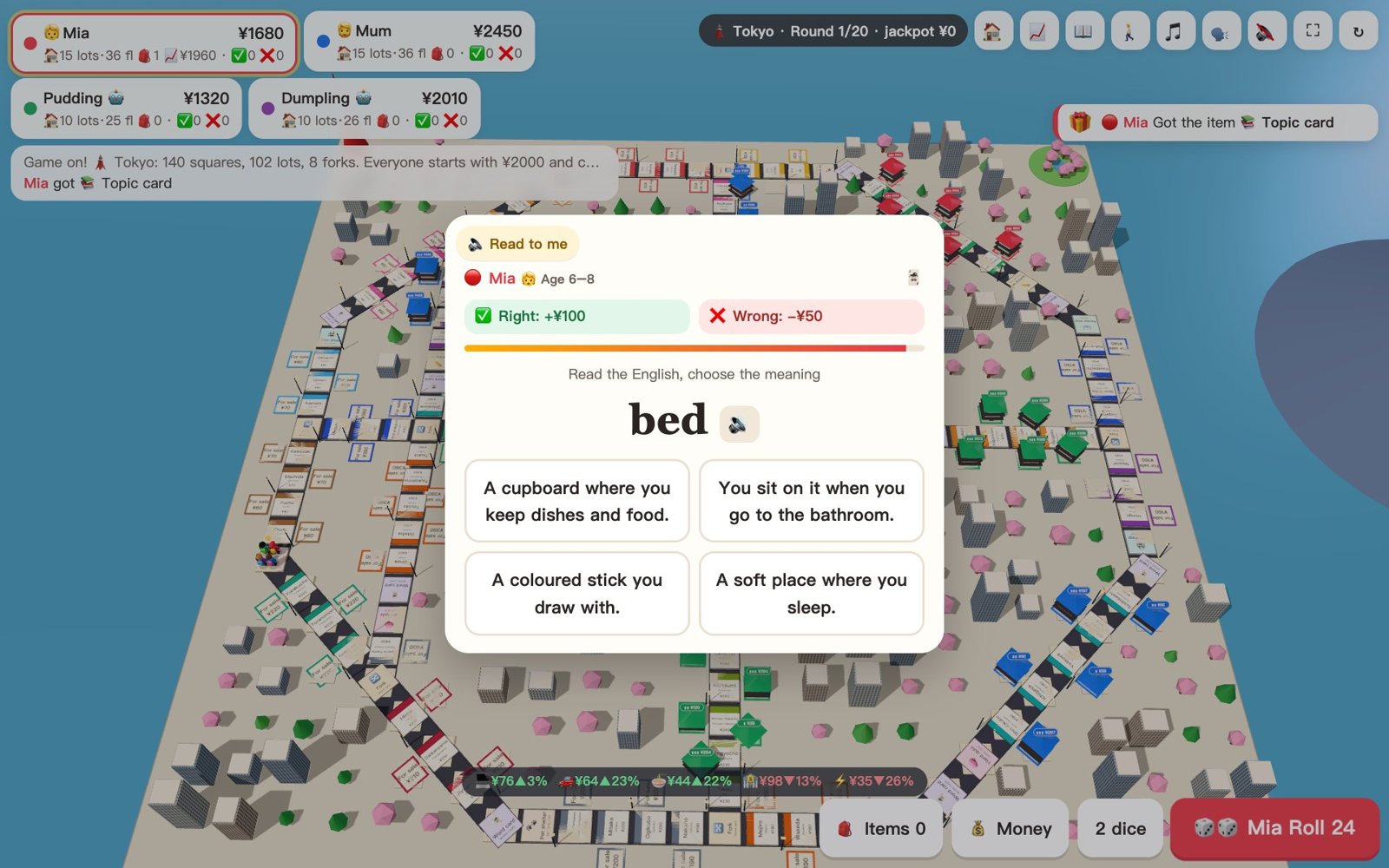
Questions only come on event squares: word cards, crossroads, spelling tax, detention, the review stop and the hard-quiz stop. Buying and building need no questions, so a game keeps moving. Detention means missing one turn, unless you have a get-out card.
| Map | Squares | Lots | Layout |
|---|---|---|---|
| New York ($) | 117 | 84 | Broadway cuts across the island and crosses 42nd and 14th Street |
| London (£) | 149 | 111 | The Thames runs across, Tower Bridge goes north to south, two long east-west streets |
| Tokyo (¥) | 140 | 102 | An octagon ring with two shortcuts crossing in the middle |
| Shanghai (¥) | 141 | 100 | The Huangpu River runs through, a diagonal street links Puxi and Pudong |
Each city uses its own currency symbol and its own house style: eaved Japanese houses in Tokyo, red pillars and curved roofs in Shanghai, apartment blocks with windows in New York and London. A game ends after a set number of rounds (20, say) or when only one human player is left. Only human players are ranked; computer players are not.
2. Everyone picks their age, and the questions follow
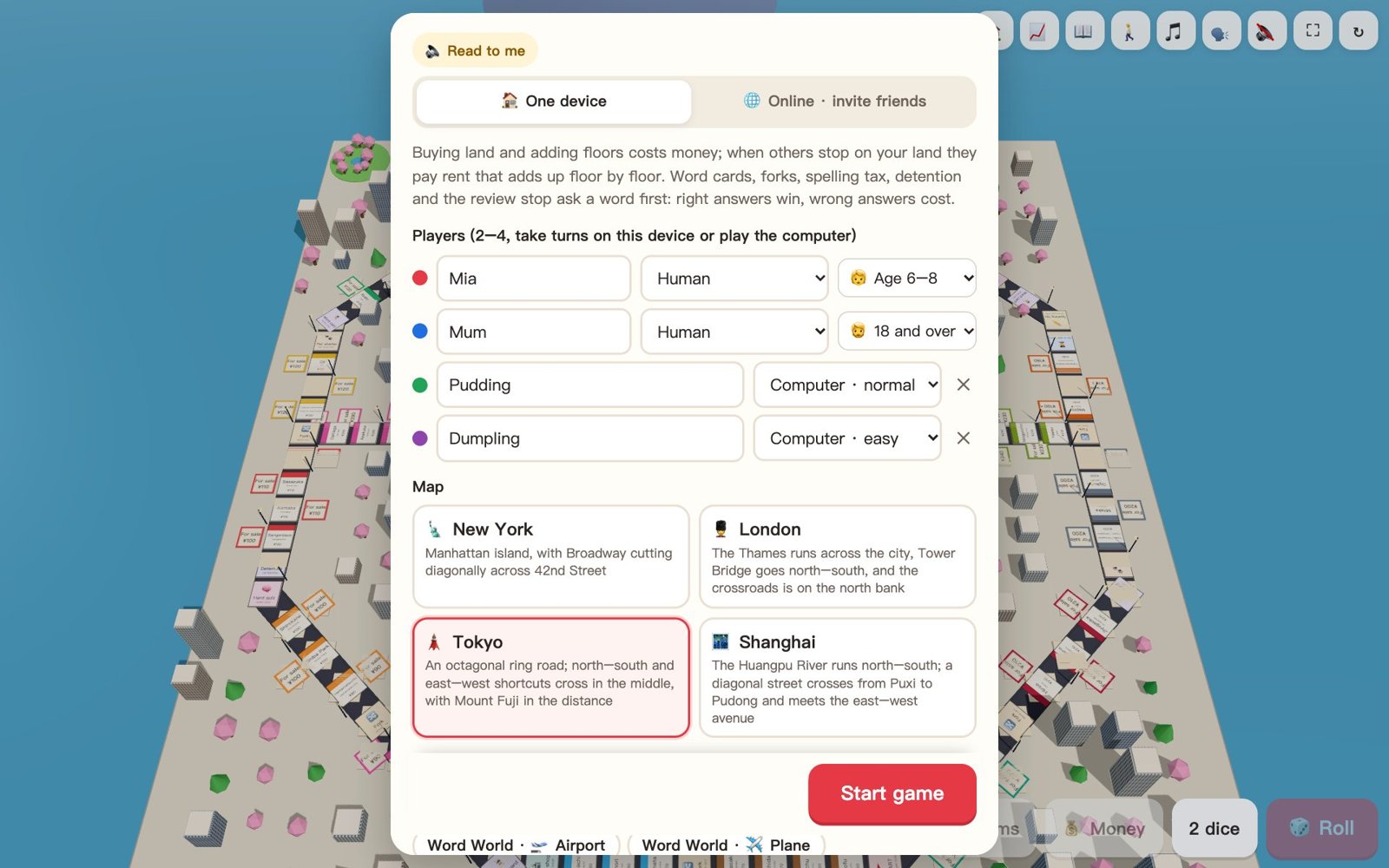
The hardest part of a family game is that children and adults are far apart in English. So every human player picks an age before the game can start; in an online room, each person picks their own after joining. From then on, each player's questions match their age:
| Age | Words | English maths | Answer time |
|---|---|---|---|
| 6–8 | Words up to 5 letters; spelling shows the first two letters | Adding and taking away within 10, like how many legs 3 cats have | 1.6 times the standard |
| 9–12 | Up to 7 letters | Simple times tables, perimeter and area | 1.3 times |
| 13–17 | All words | Discounts, distance, change | Standard |
| 18+ | Long words come up more often | Percentage rises, averages, speed, interest, ratios | 0.85 times |
Fill-in sentences are graded too: children get short ones such as brushing teeth every morning, while adults meet conditionals and inversion. At one table, each person answers at their own level, and who wins comes down to luck and money choices, not who has the best English.
3. For children who cannot read yet: every popup can be read aloud
Our younger child cannot read everything yet, so someone always had to sit beside them reading the rules. Now every popup has a 🔈 Read to me button in its top-left corner. One tap reads the title, the explanation and the choices in the language you picked; for a see-the-word question, the English word is spoken after the explanation. In the item shop and the bag, every card has its own 🔈 too.
Players aged 6 to 12 get automatic reading by default. On their turn the game says it is their turn and to tap the red Roll button; their questions, choices and results are read out, and so are the market and property news. Their dice auto-roll after 30 seconds instead of 15. The 🗣️ button at the top turns automatic reading off, and the 🔈 buttons still work after that.
Chinese and English voices are almost always there. Some Android phones lack voices for Thai, Korean or other languages, so those may not be read or may sound wrong; the voice pack can be downloaded in the phone's settings.
4. Wrong answers come back
Every player's wrong words, maths questions and fill-in sentences are counted. Until a question is answered correctly, it returns in later turns marked as one they got wrong before, and it takes two correct answers to clear it. The review stop asks only that player's missed words.
For the signed-in player, mistakes are saved to the 📖 mistake book and carried into the next game. The book shows how many times each word was missed and ticks the ones that are learned.
5. Something for the adults: maths word problems and long sentences
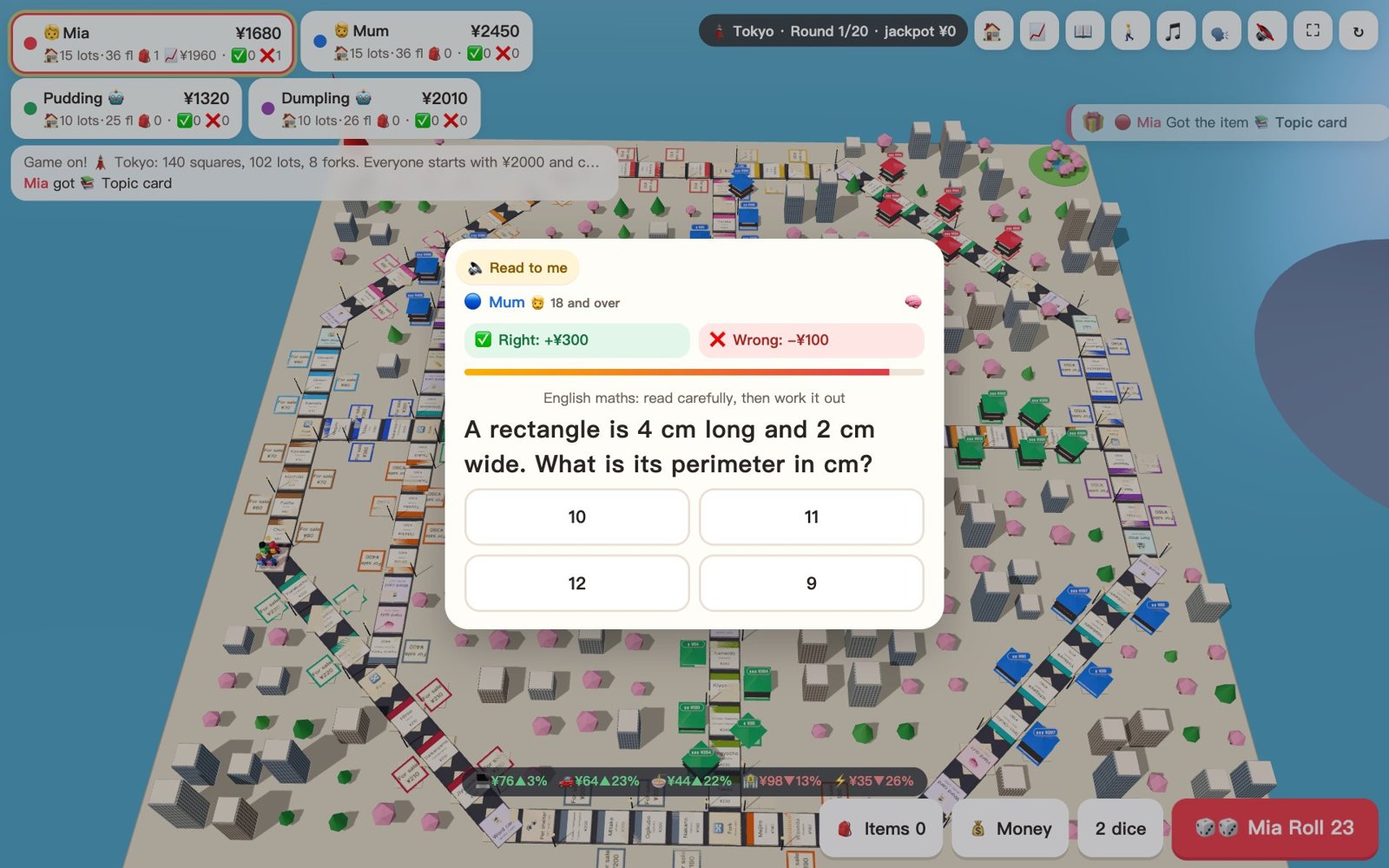
The hard-quiz stop asks harder questions for bigger rewards. One kind is a maths word problem written in English, which has to be understood before it can be solved:
- A phone costs 480 dollars. Next month the price goes up by 25%. What will the new price be? (adult level)
- A cat has 4 legs. How many legs do 3 cats have? (age 6–8)
The other is a long fill-in sentence with four choices, such as Had I known about the traffic, I ___ earlier. (answer: would have left). Adults playing board games with children need something to do too.
6. A little money sense: stocks, loans and property
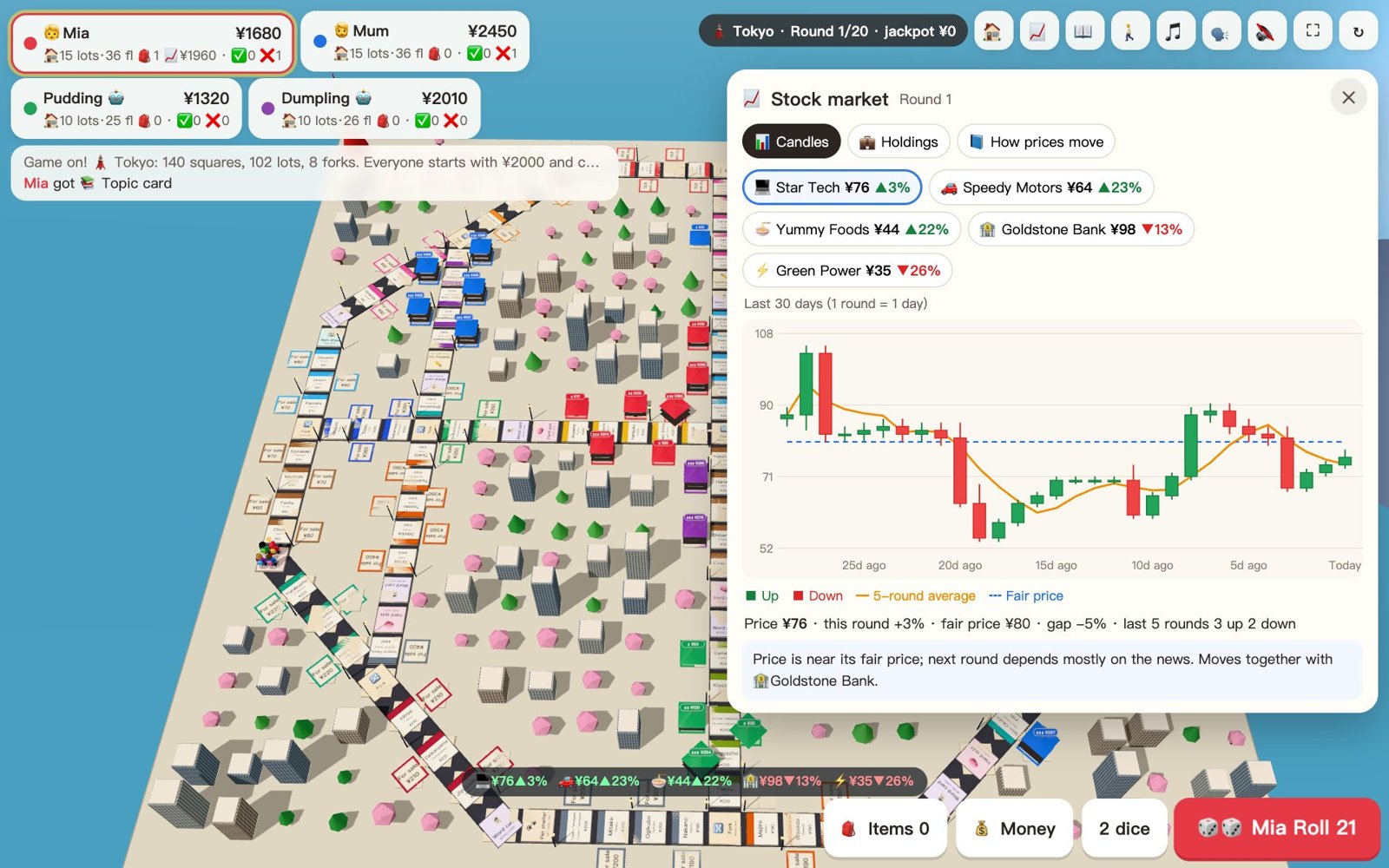
There are 5 fictional stocks, and every round starts with a market headline. The 📈 button shows 30 days of candlestick charts, every player's holdings and their profit or loss at any time. Prices follow rules, written out on the How prices move page:
- Good company news lifts a stock 12%–34% and bad news drops it as much; market-wide news moves every stock by half that.
- Each stock has a fair price that rises 3% a round. The further a price drifts from it, the harder it is pulled back.
- Cars and power, tech and bank move in pairs; food moves only half as much on market-wide news.
You can borrow from the bank in steps of 500, up to 3,000, paying 5% interest each turn. Every 3 rounds a property headline raises land prices on one street by 15%–30%, and rent follows. When you cannot pay, you choose whether to borrow, sell stocks, knock down a floor or sell land. After a few games, children start asking why anyone would buy a stock that just fell, which is worth talking about as much as any word.
7. Item cards
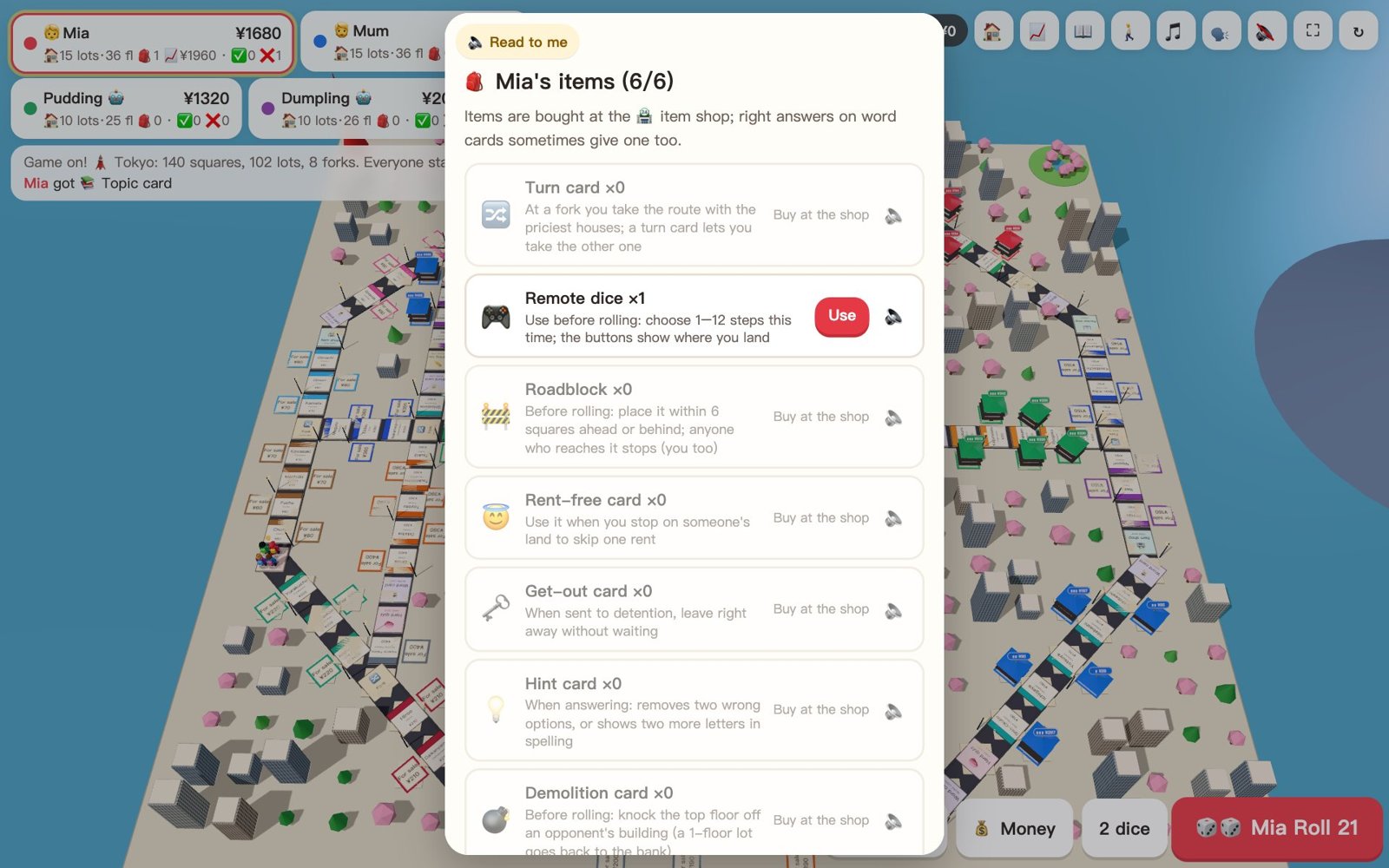
Items are bought in the item shop, and correct word cards sometimes give one. The bag holds up to 6:
| Item | What it does |
|---|---|
| 🎮 Remote dice | Choose how many steps to move, 1 to 12 |
| 📚 Topic card | Choose your next question type (listening, spelling, maths, fill-in…); get it right and the money you get this time doubles |
| 🤖 AI help card | When stuck, AI gives the answer and one line on why |
| 🤝 Share-for-all / 🫱 Share-with-one | Everyone's cash, or yours and one player's, is pooled and split evenly |
| 📉 Level-down-all / 🎯 Level-down-one | Everyone's cash, or one richer player's, drops to the poorest player's level |
| 🏷️ Buy-house / 💣 Demolish | Buy another player's lot and house / remove an opponent's top floor |
| 🚧 Roadblock, 🔀 Turn, 😇 Free rent, 🗝️ Get out, 💡 Hint | Block the road, take the other branch, skip one rent, leave detention, remove two wrong choices |
The share and level-down cards only touch cash; stocks, land and houses are left alone. The maps also have pet shelters, where donating or buying something for the animals gives random item cards, and the computer players are named after the pets you keep in GachaLex.
8. Play with friends far away, each in their own language
Open a room on the Online tab, invite GachaLex friends directly (they get a site message) or copy the link and send it. A game takes 2 to 4 players, and computer players can fill empty seats. Everyone uses their own phone or computer; if someone drops out for 12 seconds, the others can let the computer play for them until they come back.
The game speaks seven languages: Simplified Chinese, Traditional Chinese, English, Japanese, Korean, Thai and Portuguese. In one room, every device shows its own language for word meanings, news and buttons, and even the computer players' lines appear in each person's language. Our child can play with cousins in another country, each reading their own language while answering the same English questions.
Without going online, up to 4 players can take turns on one device, with or without computer players.
Frequently asked questions
Is Word Tycoon 3D free? Do I need to download anything?
It is free and there is nothing to download. It opens in a phone, tablet or computer browser; you only need a free GachaLex account.
How old does a child need to be?
Around 6. Choosing age 6–8 gives words of up to 5 letters, maths within 10 and more time to answer; popups can be read aloud, and players aged 6 to 12 get automatic reading by default.
How do children and adults play fairly together?
Each player picks their own age before the game, and the questions follow it: children answer simple words while adults get long words, percentage problems and conditional fill-ins, so the winner is not simply the best English speaker.
Can friends who speak different languages play online together?
Yes. The game supports Simplified and Traditional Chinese, English, Japanese, Korean, Thai and Portuguese. In one room each device shows its own language, and everyone answers the same English questions.