
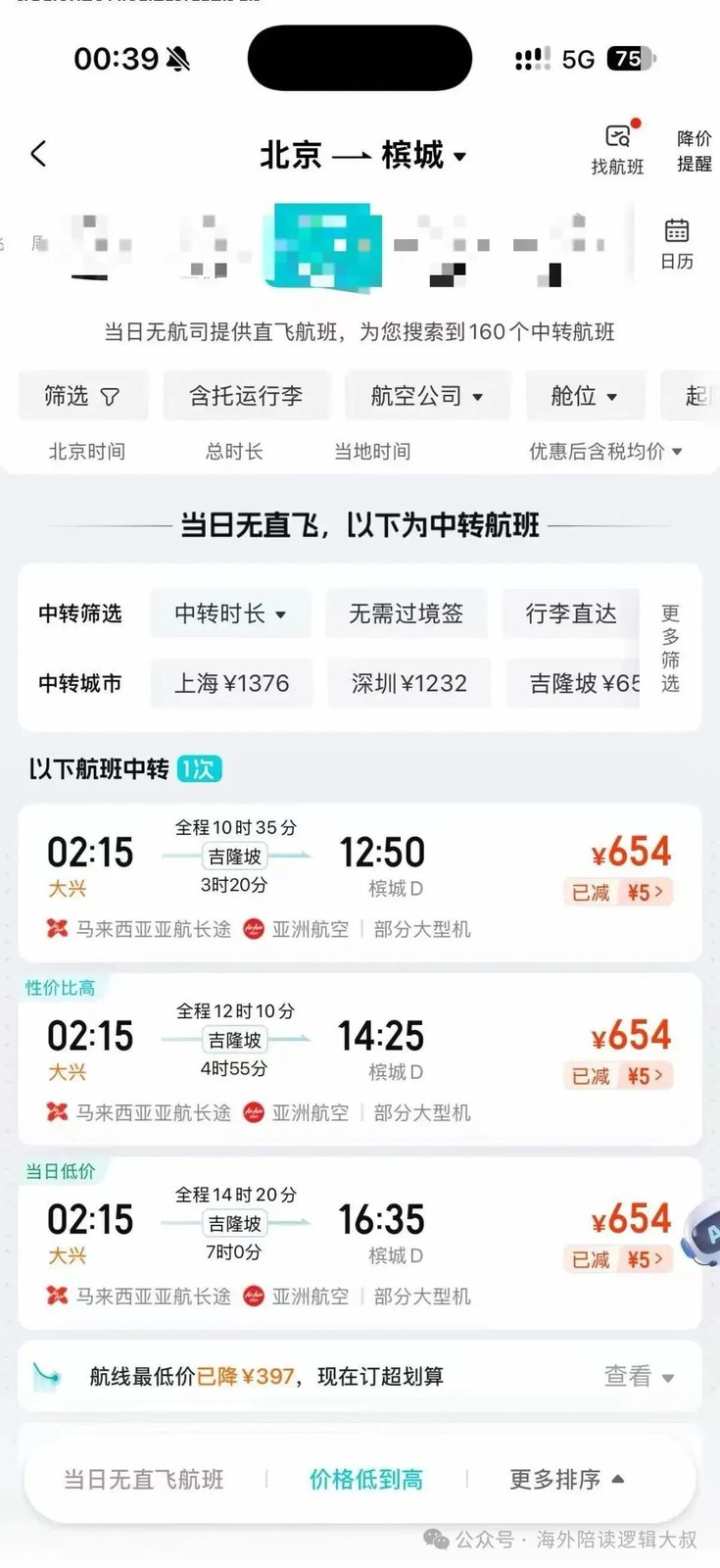
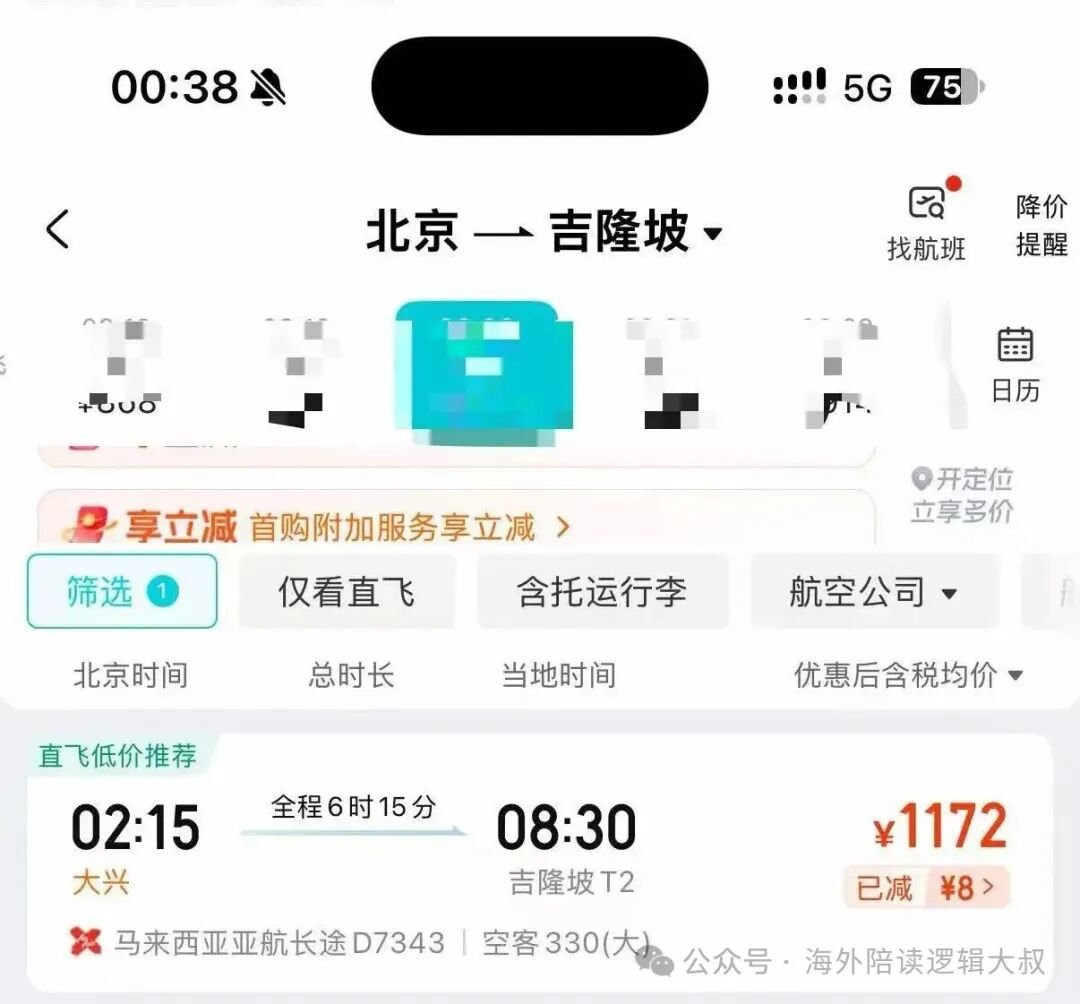
International fares are priced by fare bucket, not distance, so one extra leg can be cheaper. Booking for family, flying only as far as Kuala Lumpur cost about RM700, while the through-ticket one stop further to Penang came to about RM390. Search one stop before or after your destination, but never skip a leg of a through-ticket.
One of the most counter-intuitive things I've run into while booking flights: on the same trip, flying further can be cheaper. No tricks here, just the handful of things I've repeatedly verified when buying international tickets: where to search, what to search for, and the differences hidden inside a single booking.
1. Start with one premise: fares aren't about distance, they're about fare buckets
Most people assume the further you fly, the more you pay. Airlines barely price by kilometres; they price by fare buckets. On one route, several separate price systems can coexist — promo fares, plain one-way fares, bundled connecting fares — each with its own allocation and rules. What you see isn't "the price of the route" but "the price of whichever bucket you happened to hit".
That is how you get a ticket that covers more ground and more hours yet costs less. It isn't a glitch; it's the airline using price to keep your whole journey inside its own network.
2. Don't search nonstop only: move the destination one stop further
The clearest example came from booking for family. The real destination was Penang, so I first searched just Beijing–Kuala Lumpur: on that date, flying only to the connecting city, taxes included, came to about RM700. Then I searched the full Beijing–Kuala Lumpur–Penang through-ticket: about RM390, taxes included. Adding one more leg cut more than RM300 off the price.
Two things explain it:
- Two completely separate fare buckets. The cheap through-ticket is a promo bucket for "international plus domestic connection", because the airline wants that domestic leg on its own metal too. The expensive one is a plain international one-way bucket for travellers entering Malaysia at Kuala Lumpur. The two are priced independently, with no reference to each other.
- Commercial strategy. Airlines don't want you flying their international leg and then switching carriers inside the country, so they bundle international and domestic into a discounted package and use the low price to lock the entire trip into their own network.
The reusable move is simple: never search only your target city — search one stop before or after it as well. Heading to Kuala Lumpur? Also try Penang. Heading to Bangkok? Also try Chiang Mai. The condition is that you genuinely intend to travel the extra leg.
Don't buy Beijing–Kuala Lumpur–Penang and fly only the first leg. If you abandon any segment of a through-ticket, the airline may cancel everything that follows. To get this fare, you have to fly the whole thing.
3. Nearby-city ticketing: swap the departure point as well
The same logic works in reverse — it isn't only the destination you can shift, but the departure city. On one peak-summer trip, five of us needed to get from Penang back to Beijing. The default plan was Penang–Kuala Lumpur/Chengdu/Guangzhou–Beijing: roughly RM780–900 per person and more than 20 hours in the air, overnight and exhausting.
We took a different path: Penang–Singapore–Tianjin, a little over RM540 per person and 9 hours 15 minutes of flying. On arrival we picked up a rental car and drove north; rental plus one-way drop-off, fuel and tolls came to about RM180–240, and split five ways it beat any other option. All in, it saved close to RM1,200 against the standard plan — and, more importantly, more than ten hours of flying.
| Dimension | Standard plan (landing in Beijing) | Optimised plan (landing in Tianjin) |
|---|---|---|
| Sample routing | Penang–Kuala Lumpur/Chengdu/Guangzhou–Beijing | Penang–Singapore–Tianjin |
| Fare per person | About RM780–900 | About RM540 |
| Total flying time | Over 20 hours | About 9 h 15 min |
| Final leg | Taxi from the airport | Self-drive rental car |
One caveat: this path works when you have homes on both ends and no cargo to move. We stuck to one backpack each, which sidesteps budget-airline checked-baggage fees entirely. Scoot's cabin allowance is typically 10 kg, and backpack-only travellers clear the gate faster.
4. Flexible dates: off-peak, open-jaw, and a way back out
Dates are the cheapest variable to move and the one most often overlooked.
- Go off-peak. Departing mid-holiday and taking a few extra days off after the peak is visibly cheaper and quieter. Shifting by a day or two can move the price a long way.
- Fly into one city, out of another. For two theme parks in Japan, flying into Tokyo and out of Osaka, with a shinkansen in between, avoids backtracking and usually costs less than using one airport both ways.
- Leave yourself room on the return. Swapping a nonstop for one connection (say Osaka–Qingdao–Beijing) saves a few hundred ringgit; travelling with kids it is more tiring, but the saving pays for a couple of extra meals on the ground.
There is also a rule more important than price: with kids, don't gamble on non-refundable cheap fares. Change your plans and the cheapest tickets often refund nothing. Paying a little more for a refundable fare buys the ability to start over. Same for hotels — favour free cancellation.
5. Hidden differences inside one booking: baggage and change rules
Same route, same headline price, very different rights attached — and this is exactly what the fare number hides.
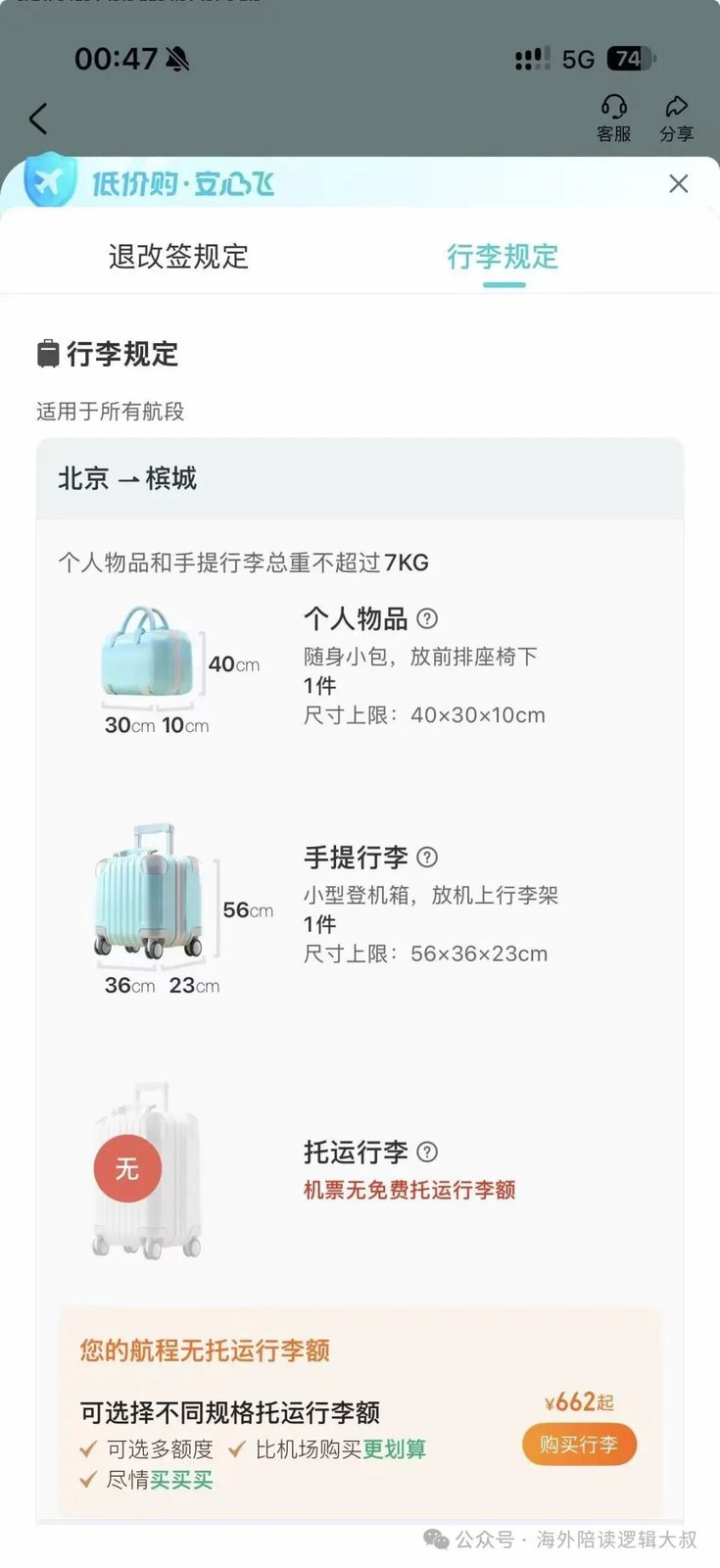
- Free checked baggage. Low fares often include none. A typical AirAsia promo ticket covers cabin baggage only: one carry-on plus one small personal bag, two pieces capped at roughly 7 kg combined. Years ago, ground staff rarely weighed the personal bag; now some gates weigh randomly and count both together, and buying an allowance at the gate costs far more. If you have luggage, buy the allowance when you book.
- Change and refund rules. The cheaper the bucket, the tighter the rules — some tickets cannot be refunded at all, others convert only to credit, and fully refundable fares cost more.
- Channel differences on the same ticket. Third-party platforms may not show every fare class, and any refund or change has to go back through them.
A simple habit fixes this: compare fare + baggage + the cost of changing your mind, not the headline number.
6. Layover practice: trust the airport screens, not the printed boarding pass
Money-saving itineraries usually involve one connection, so how well you execute the layover decides whether the saving is worth it. Transiting Singapore Changi, I was nearly undone by a boarding pass. Both passes were printed at check-in, and the second gate was printed as "Zone C", so that is where I went. The first flight ran late; on landing I had about an hour left. I ran to Zone C and the officer told me the flight was not there at all — the real gate turned out to be directly opposite the exit I had just walked out of.
Three rules I have kept since:
- Check the screens on landing and treat them as the source of truth, not the pass printed before departure.
- Listen for English announcements — gate changes and delays are usually announced once, in English.
- Locate first, decide second: on a tight connection, go straight to the next gate to confirm where it is before thinking about the lounge. Changi's lounges serve hot food around the clock; if time allows, a meal there beats paying onboard.

7. One table: the common money-saving moves and what they cost you
| Move | Typical saving | Cost / condition |
|---|---|---|
| Search one stop past your destination (through-ticket) | Around RM300 | You must fly the whole itinerary; no skipping legs |
| Use a nearby departure or arrival city | RM200 to a few hundred | Extra ground transport; rental or transfer needed |
| Off-peak, flexible dates | Route-dependent | Your trip is tied to the dates |
| Accept one connection | A few hundred ringgit | Longer travel; more baggage and change risk |
| Cabin baggage only | A few hundred each | A strict 7–10 kg cap; you must pack light |
8. The pre-booking checklist
Compress all of the above into a few actions before you pay:
- Search your target city, then search one stop before or after it and compare the tax-inclusive total.
- For the same trip, search from a nearby departure city as well.
- Shift your dates a day or two either way and watch how the price moves.
- Check the baggage allowance, the change and refund rules, and whether it is a through-ticket before deciding where to buy.
- If it is a through-ticket, confirm bags are checked through, the connection time is comfortable, and trust the airport screens on arrival.
Airfares were never determined by distance — they are the product of fare buckets, promotions and airlines competing for passengers. Try one more destination, one more date, and you may well save a few hundred ringgit — enough for a couple of good meals along the way.
Frequently asked questions
Why can flying further cost less?
Because airlines price by fare buckets. A connecting promo bucket and a plain international one-way bucket are separate allocations with separate rules, which produces the inversion where a longer trip costs less.
Can I buy a through-ticket and only fly the first leg?
No. If you abandon any segment of a through-ticket, the airline may cancel everything that follows, and it can affect your loyalty status and future bookings. To get the fare, you must fly the whole itinerary.
When and how should I search for flights?
Search as early as your plans allow, compare dates a day or two either side, and always search one stop before or after your destination. Travelling off-peak is usually clearly cheaper.
What should I check about baggage on a cheap fare?
Low fares often exclude checked baggage, and cabin baggage is commonly capped at two pieces totalling 7–10 kg. Gates weigh bags at random, and buying an allowance there costs far more, so add it at booking.