
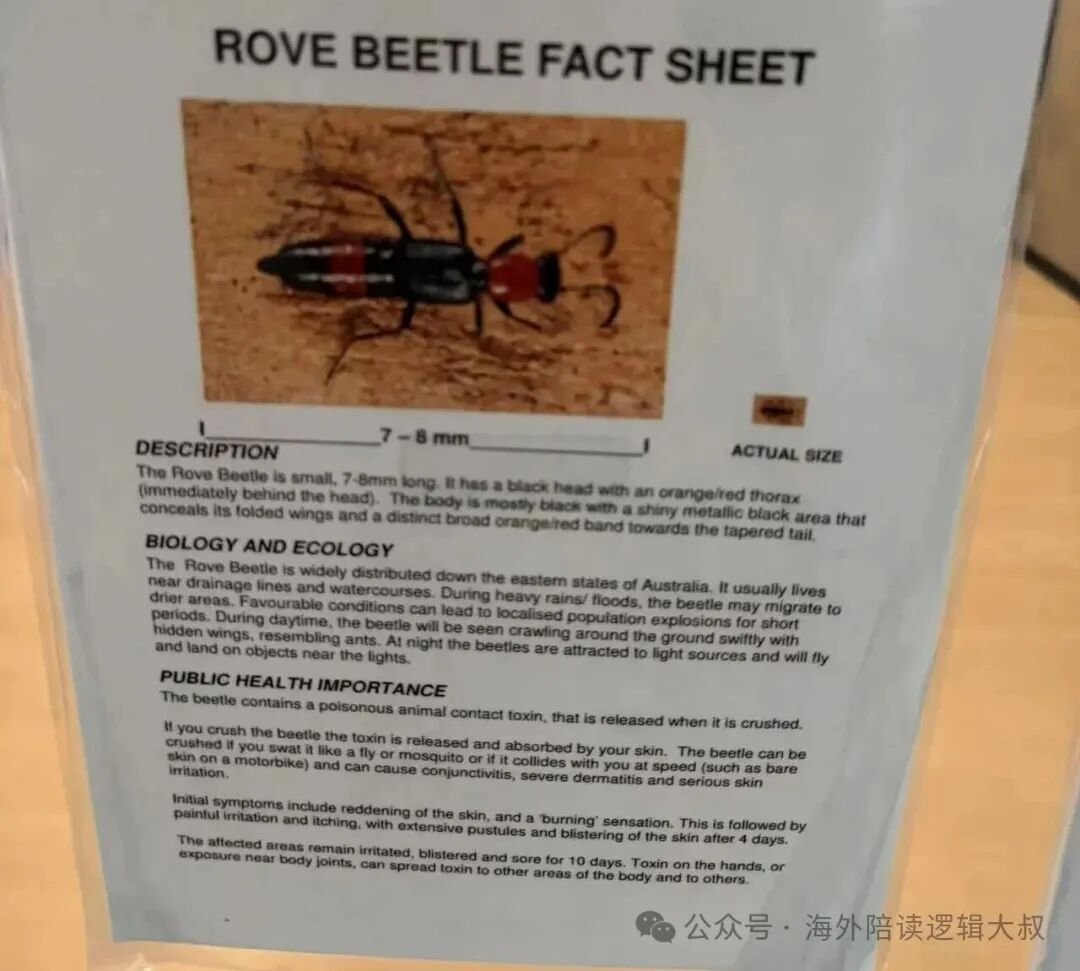
Rove beetles do not bite or sting; the danger is crushing one against your skin, which releases a contact irritant called paederin. Symptoms usually appear 12 to 48 hours later as linear streaks. Blow the insect away rather than swatting, and if contact happens, rinse with soap and water and wash your hands first.
1. The rainy-season visitor: getting to know the rove beetle
Live in Malaysia for a while and every rainy season brings the same warning: do not swat that ant-like insect at night. It is a rove beetle, known in parts of East Asia as the "blue ant". The name says ant, but it is actually a beetle: slender, banded in orange and black, usually only a few millimetres to a centimetre long. By day it hides in damp grass, field edges and drains; at night it is drawn to light, flying indoors and landing on people.
The crucial point is that it does not bite and does not sting, and it carries no stinger. The real trouble is its body fluid, which contains a contact irritant called paederin. That fluid only reaches your skin when the insect is swatted, crushed or pressed. So the whole rule comes down to one line: do not swat it — blow it away or flick it off.
Why the emphasis on the rainy season? Across Southeast Asia these beetles become noticeably more common after rain and in the wetter months. At the same time, lighter clothing and open windows with the lights on mean more exposed skin. It is about weather and light, not about how clean your home is.
2. Why you should not swat: the danger is the crushing motion
For most people the first reaction is a reflex slap. That is exactly the motion that squeezes the fluid out of the insect and spreads it across the skin, often over a fairly large area. The skin reaction usually appears only 12 to 48 hours later, so nothing seems wrong at first and the problem shows up the next day.
The typical result is one or more streaks of reddened skin, looking like a scratch or a mild burn, sometimes followed by small blisters with a burning, stinging feel. Because it commonly appears on exposed areas such as the neck, arms and calves, and the shape is linear, it can look as though something lashed the skin — hence the informal English name, whiplash dermatitis.
One more thing deserves attention: the fluid travels on your fingers. Rub your eye or touch your cheek before washing your hands and you can carry the irritant to a new spot. Around the eyes this is especially awkward, and involvement on both sides is not unusual. After contact, washing your hands matters more than treating the skin itself.
This article covers general principles and when to seek care. It is not a diagnosis and it does not recommend any specific medicine. Whether to use a cream, and which one, is a decision for a doctor.
3. The first step after contact: rinse, do not rub, do not scratch
If the insect has already been crushed against your skin, this is what to do:
- Rinse the area right away with running water and soap, gently, for a few minutes, to dilute whatever fluid remains. Do not scrub hard, and do not wipe the fluid sideways with a towel.
- Wash your hands. Soap and water, especially the fingertips and between the fingers — the step most often skipped, and the one that spreads the irritant.
- Keep your hands away from your eyes. Until they are properly washed, do not rub your eyes or touch your face.
- Do not pop blisters and do not scratch. Broken skin invites bacterial infection, and scratching widens the area and deepens the mark.
- Do not improvise with home remedies. Toothpaste, medicated oils, herbal balms and vinegar do not help and may irritate the skin further. Whether a steroid or antibiotic cream is appropriate, and which one, is for a doctor to decide.
A cool compress can ease the burning: use a clean damp towel over a thin cloth, not ice directly on the skin. Keep the area clean and dry, and wear loose clothing to reduce friction. That is usually enough.
Flush the eye with clean water or saline immediately for at least ten to fifteen minutes, without rubbing, then go to a clinic or hospital emergency department as soon as possible rather than waiting for the next day. Eye involvement should be treated as a priority.
4. The next few days: a rough timeline
Reactions vary a lot from person to person. The table below describes the general pattern to help you judge whether things are in the usual range; it does not replace a doctor's assessment.
| When | What is often seen | What you can do |
|---|---|---|
| At the moment of contact | Usually nothing noticeable | Rinse at once and wash your hands thoroughly |
| 12-48 hours | Redness, burning, stinging, linear streaks | Keep it clean; do not scratch or apply home remedies |
| Days 2-5 | Possible blisters and local swelling, more noticeable pain | Do not pop them; see a doctor if the area is large or very painful |
| 1-3 weeks | Gradual crusting, peeling and healing | Protect from sun, reduce friction |
| Weeks to months after | A light brown mark where it healed | Common; avoid sun exposure and it fades over time |
5. When you must see a doctor
Most cases settle with simple home care, but do not delay in these situations:
- The fluid reached your eyes, or your eye is red, painful, sensitive to light or your vision is blurred.
- The rash is on your face, especially near the eyes, or on the genitals.
- It covers a large area or is spreading quickly, with marked swelling or severe pain.
- There are signs of secondary infection: pus, worsening pain, redness spreading outwards, fever or swollen lymph nodes.
- Several days have passed and it is getting worse rather than better.
- The person affected is an infant, an older adult, pregnant, or has a weakened immune system — for them, set the threshold lower and seek care early rather than waiting.
And if you are not sure what you are looking at, do not try to match it against photos online. Conditions such as shingles or impetigo can look similar and need to be seen in person.
6. Prevention: adjust the lights, the screens and your evening habits
- Close windows or use insect screens at night. Many homes in Malaysia have unscreened windows; during the rainy season, keep them closed and draw the curtains, or fit removable mesh screens — a point that fits naturally with the windows and doors discussed in how Malaysian condos are designed.
- Cut the bright light facing the window. The beetles come to the light. An open window plus bright indoor lighting is an open invitation; use warmer light, draw the curtains, or leave lights off in empty rooms.
- Do not sit for long under outdoor lights. Lingering on a balcony, in a corridor or under a street lamp at night clearly raises the odds of a landing.
- Wear long sleeves and long trousers outdoors in the evening. A physical barrier is the simplest defence, which is also why lighter clothing means more encounters.
- Shake things out before you wear them or lie down. Give clothes, towels and sheets dried outside a shake, and glance at the pillow and blanket before bed.
- If something lands on your skin, pause for a second. Look before you act — that one-second habit prevents most of the trouble.
7. A few common myths, settled
| What people say | What is actually true |
|---|---|
| "It is more venomous than a cobra." | This is an exaggeration. Paederin is a contact irritant, not a venom injected into the body, and the insect cannot bite or sting. The usual outcome is a painful rash, not envenomation. |
| "Killing it solves the problem." | The opposite. Crushing it is what releases the fluid and starts the problem. |
| "It spreads to your family." | It is not passed from person to person. But fluid on your hands can reach other parts of your own body, which is why handwashing matters. |
| "Toothpaste or herbal balm will fix it." | Not recommended. They can worsen the irritation; let a doctor decide on treatment. |
The point of spelling this out is not to frighten anyone — quite the opposite, because it is entirely manageable. Two things are worth remembering: do not swat, and rinse and wash your hands immediately after contact. The rest is time and, when needed, a doctor. If you want to revisit the practical side of rainy evenings, a read like getting around Penang without a car is a good reminder to adjust your route and timing home, which also means fewer encounters with insects.
Frequently asked questions
Does a rove beetle bite, and is any contact a problem?
It neither bites nor stings and carries no stinger. The skin problem comes from its body fluid, which only reaches your skin when the insect is swatted or crushed. If it simply lands and flies off again, there is normally nothing to worry about.
How soon do symptoms appear after contact?
Usually 12 to 48 hours later, so nothing seems wrong at first. The typical sign is a linear streak of reddened skin with burning and stinging, sometimes followed by small blisters.
What should I do first?
Rinse the area gently with running water and soap for a few minutes, then wash your hands thoroughly, especially the fingertips and between the fingers. Do not rub your eyes or touch your face before your hands are clean. Do not pop blisters, do not scratch, and skip home remedies such as toothpaste or herbal balms.
When do I definitely need to see a doctor?
If the fluid reached your eye; if the rash is on the face or genitals; if it is large or spreading quickly; if there are signs of infection such as pus or fever; if it is not improving after several days; and for infants, older adults, pregnant people or anyone with a weakened immune system, who should seek care early.