
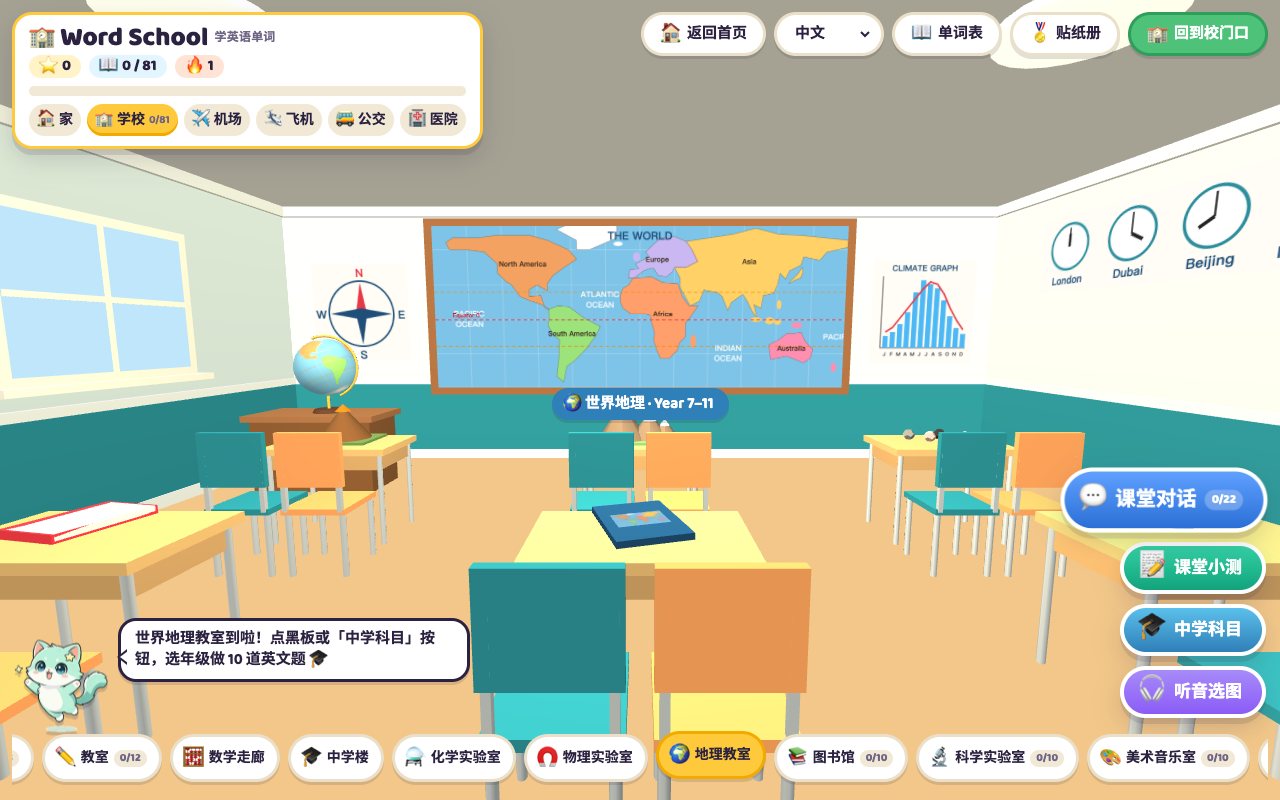
Word School in Word World now has a secondary wing with a chemistry lab, a physics lab and a geography room. Each subject has Year 7 to Year 11, with 15 English four-choice questions per year, 225 in total. A round picks 10 at random, read aloud, with retries; right first time earns a star. Each right answer shows a one or two sentence English explanation with a translation, and the end screen lists missed questions. The questions are original practice, not official exam papers. Free; needs a free GachaLex account.
Since my child moved to an international school, the most common problem with science homework has not been the science but the question itself: asked Which gas turns limewater milky?, he knew the answer was carbon dioxide but had never met the word limewater. Word World's School already had school words, classroom dialogues and Year 1 and 2 maths in English. This update adds the secondary years.
1. Where the secondary wing is
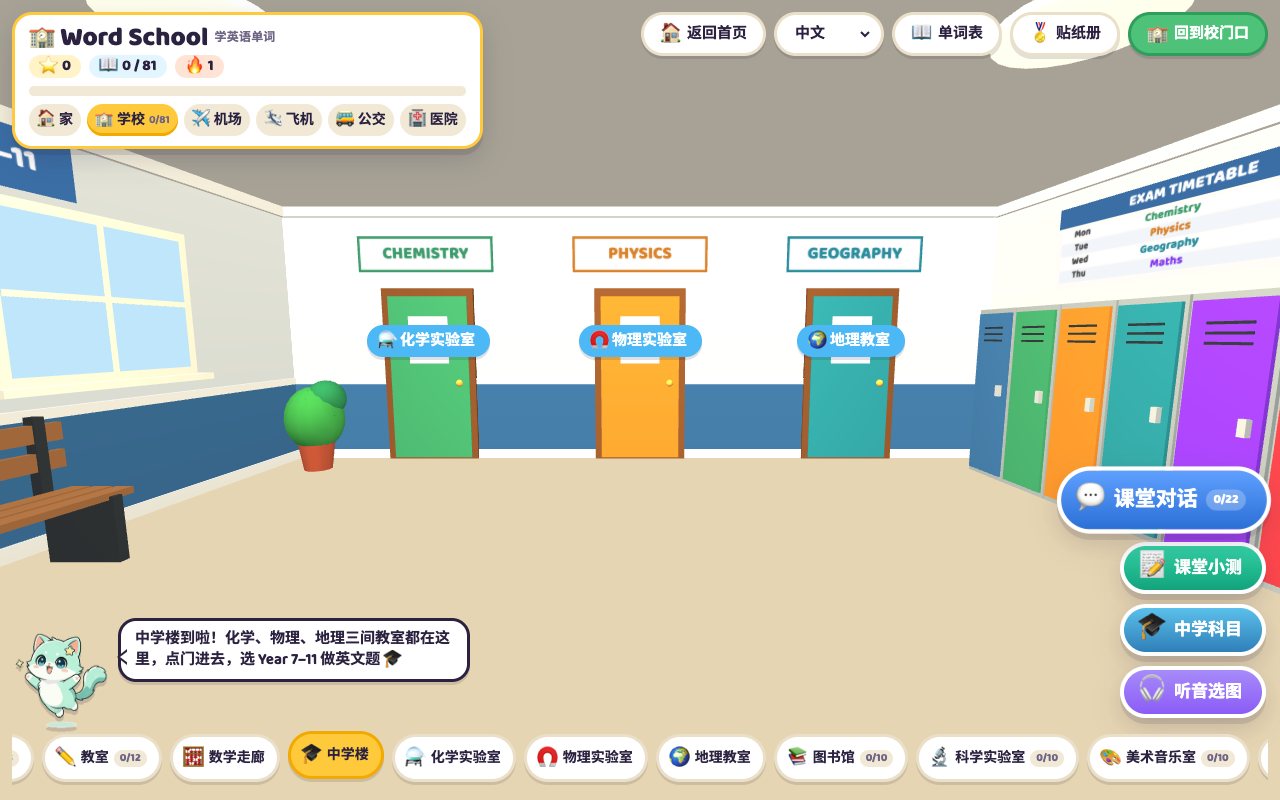
Open Word School, walk through the gate into the hallway, and there is a new dark blue door on the south wall marked Year 7–11. Behind it is a secondary corridor: three doors on the north wall lead to the CHEMISTRY lab, the PHYSICS lab and the GEOGRAPHY room, with lockers and an exam timetable on the east wall. You can also use the room bar at the bottom, or the new Year 7–11 button at the bottom right, which asks for a subject and then walks you to that room.
2. What is in each room
| Room | Board and walls | Benches and desks |
|---|---|---|
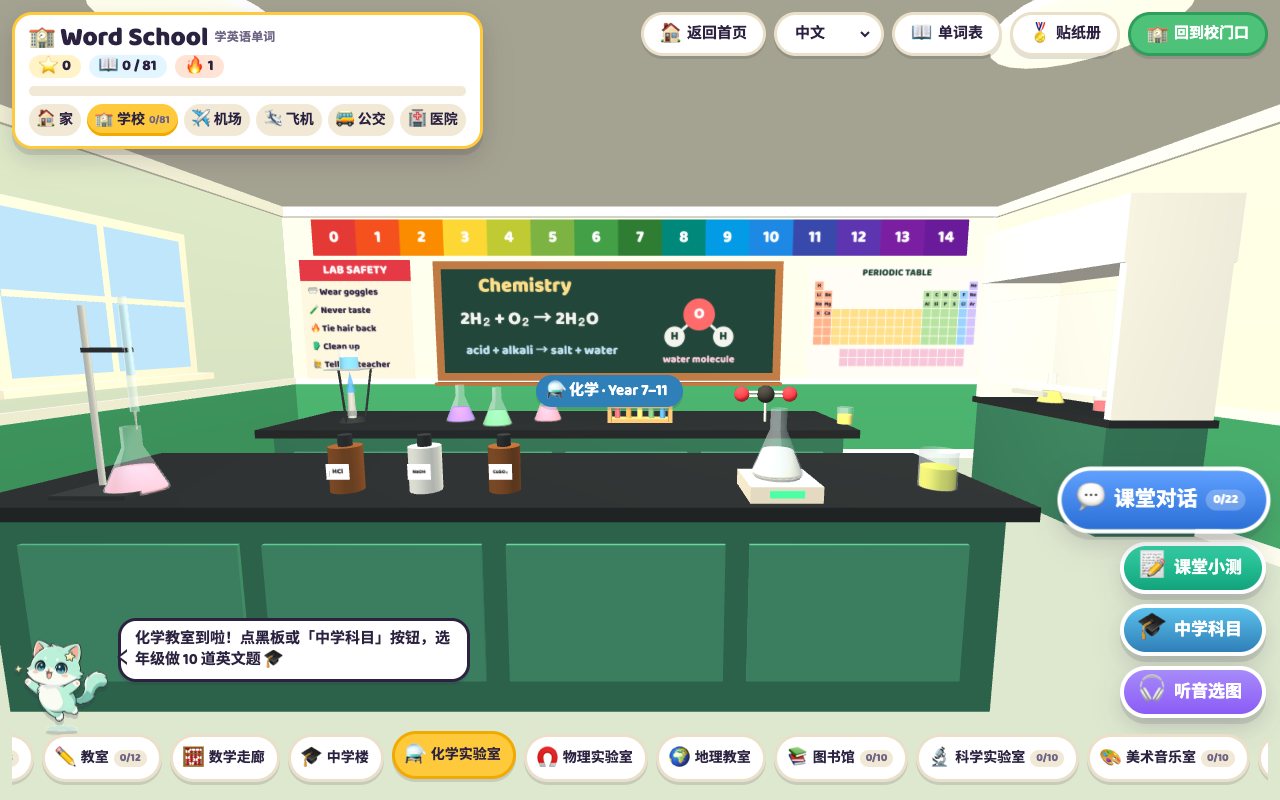
| Chemistry lab | 2H₂ + O₂ → 2H₂O, a water molecule, a pH 0–14 strip, a periodic table with the first 20 elements, lab safety rules | Bunsen burner and tripod, conical flasks, test tube rack, burette stand, reagent bottles, balance, a carbon dioxide model, a fume cupboard |
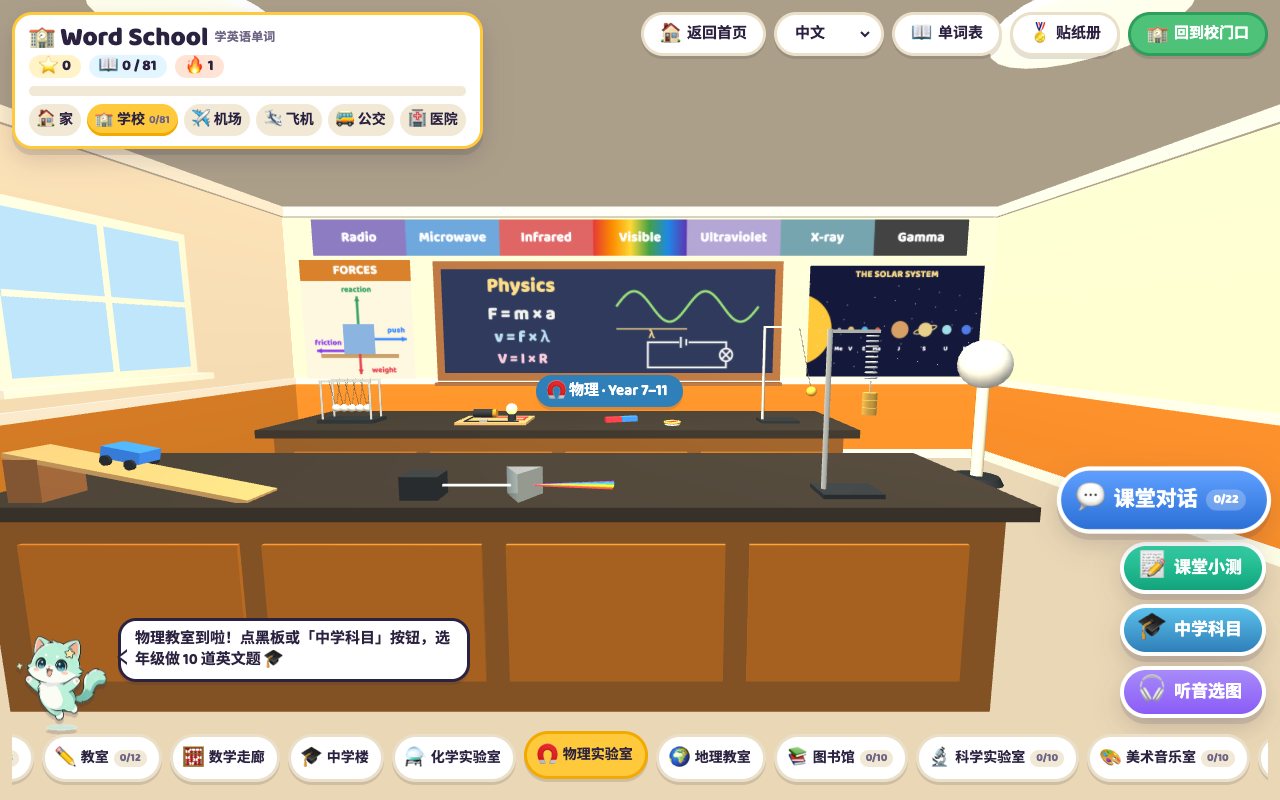
| Physics lab | F = m × a, v = f × λ, V = I × R, an electromagnetic spectrum strip, a solar system poster, a forces diagram | Newton's cradle, a circuit board with a lit bulb, bar magnet and compass, a swinging pendulum, a ramp and trolley, a prism splitting light, a spring with masses, a Van de Graaff generator |
| Geography room | A world map with the equator and tropics, a compass rose, a climate graph, clocks for London, Dubai, Beijing and New York | A spinning globe with a tilted axis, a volcano model, a mountain model, rock samples, an atlas |
The decorations match the questions: when a question mentions pH, the electromagnetic spectrum or the tropics, the answer is on the wall. Tap the board (the world map in the geography room) to start.
3. Ten questions a round, with an explanation after each
Each room first asks for a year. Years 7, 8 and 9 are marked Lower secondary, and Years 10 and 11 IGCSE level. Every subject has 15 questions per year, and each round picks 10 at random, with four choices each.
- Everything is in English, and the speaker button reads the question aloud. Formulas and units are spoken properly, so H₂O is read as H 2 O and m/s² as metres per second squared.
- A wrong choice does not reveal the answer, so the child tries again. Right first time earns a star, and a perfect 10 earns two more.
- The explanation appears as soon as the answer is right: one or two English sentences on why, with a translation underneath and a speaker button. The other choices fold away to make room.
- At the end of a round, every question not answered right first time is listed with the answer and explanation, and a good score unlocks a one-tap move to the next year.
On non-English pages, questions, choices and explanations come with a translation (Chinese, Japanese, Korean or Thai), and the Translate button at the top hides them for English-only practice. The best score for each year is saved in the browser.
4. What each year covers
| Year | Chemistry | Physics | World Geography |
|---|---|---|---|
| Year 7 | States of matter, solutions, filtration, evaporation, chromatography, pH, physical and chemical change | Forces and newtons, weight and mass, speed, magnets, sound and light, simple circuits | Continents and oceans, latitude and longitude, map scale, compass directions, the biggest mountains, rivers and deserts |
| Year 8 | Symbols, compounds, word equations, combustion, metals and acids, diffusion | Pressure, frequency and pitch, reflection and refraction, heat transfer, series circuits | Weather and climate, biomes, rock types, the water cycle, time zones |
| Year 9 | Atomic structure, electron arrangement, groups, the reactivity series, neutralisation, rates | Moments, efficiency, V = IR, electromagnets, Hooke's law, the solar system | Plate boundaries, the Ring of Fire, earthquakes and tsunamis, HDI, urbanisation, globalisation |
| Year 10 | Ionic and covalent bonding, isotopes, relative formula mass, moles, electrolysis, gas tests | Acceleration, F = ma, momentum, density, wave speed, the EM spectrum, work and power | Population pyramids, demographic transition, river and coastal landforms, tropical cyclones, ecosystems |
| Year 11 | Concentration, catalysts and equilibrium, the Haber process, redox, organic chemistry, extracting metals, Rf values | Electrical power, radioactivity and half-life, fission and fusion, transformers, specific heat capacity, redshift | Grid references and contours, sustainable development, food and water, desertification, hazard management, tourism |
That is 3 × 5 × 15 = 225 questions in total. I wrote them myself around common international curriculum topics, to build familiarity with the English. They are not official questions from any exam board, and the site has no connection with Cambridge or any other exam organisation.
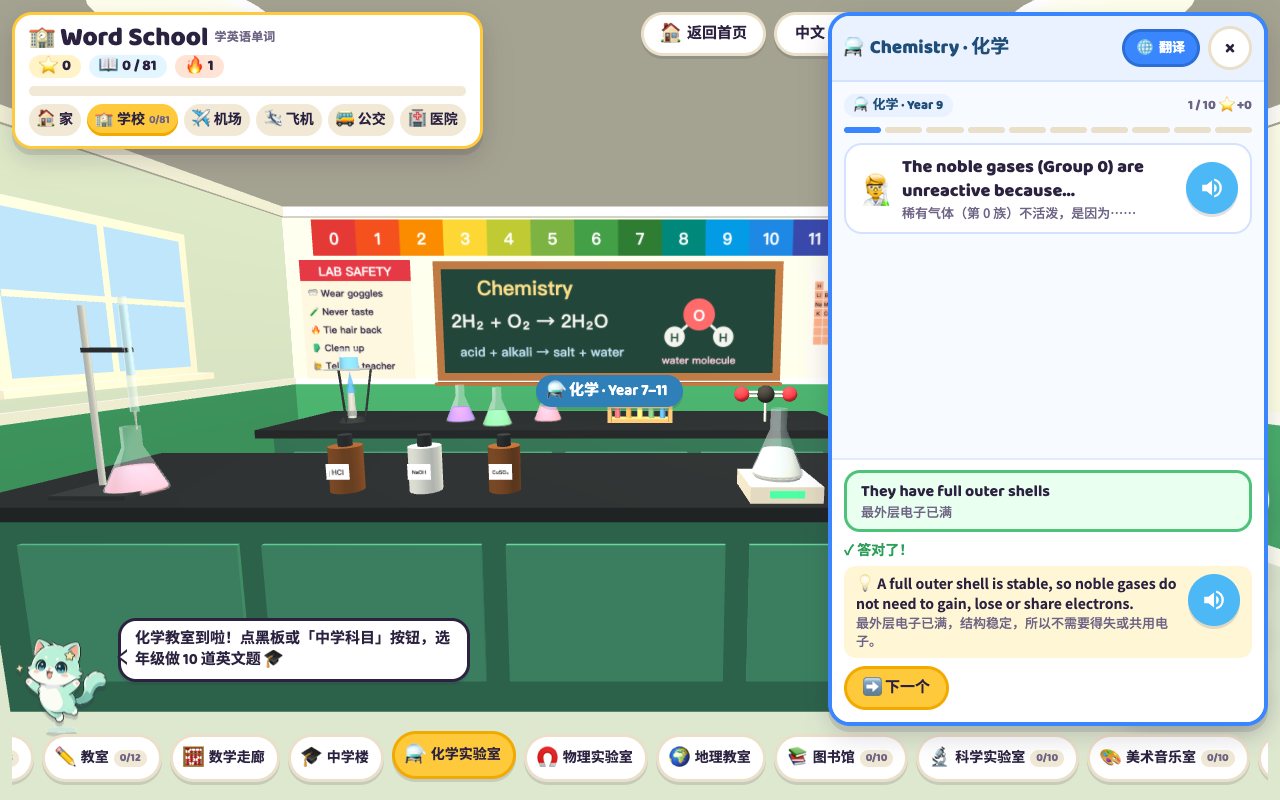
5. What the explanations look like
Chemistry, Year 9: Iron is added to copper sulfate solution. What happens? The answer is Iron displaces copper, explained as: Iron is more reactive than copper, so it pushes copper out of its compound: iron + copper sulfate → iron sulfate + copper.
Physics, Year 10: A wave has a frequency of 50 Hz and a wavelength of 2 m. What is its speed? The answer is 100 m/s, and the explanation simply substitutes into the formula: v = f × λ = 50 × 2 = 100 m/s.
Geography, Year 10: How does an oxbow lake form? The answer is A meander is cut off from the river, explained as a sequence: erosion narrows the neck of the meander, a flood cuts through, and deposition seals off the old loop.
I tried long explanations and my child skipped them. One or two sentences, one substitution or one sequence is enough to connect the key word in the question, such as displace, frequency or cut off, so it is recognised the next time it appears in a textbook.
6. How I suggest using it
- Start one year below the current one. A Year 9 student can begin with Year 8 and move up after scoring 8 or more. The goal at first is fluent English, not new content.
- Do a round with translations off, then turn them on while reading the explanations for wrong answers and note the key words in both languages.
- One round a day is enough. Ten questions take about five minutes. Rotating the three subjects gives two or three rounds of each per week.
- Link it to the textbook: ask the child to find a word from the explanations, such as neutralisation or subduction, in their own school book and see how the teacher uses it.
The secondary wing is part of the School scene: free, with a free GachaLex account needed to play, and it works in phone and computer browsers. For how the six scenes fit together, see the Word World overview.
Frequently asked questions
Which subjects and years are covered?
Chemistry, physics and world geography, each with Year 7 to Year 11. Every year has 15 questions, 225 in total. Years 7 to 9 are lower secondary, and Years 10 and 11 are around IGCSE level.
How does a round work?
Ten four-choice English questions are picked at random from the chosen year, with read-aloud. A wrong choice can be retried; right first time earns a star and a perfect round earns two more. Each right answer shows an English explanation with a translation, and the end screen lists missed questions.
Are these official IGCSE questions?
No. They are written around common international curriculum topics to practise the English of science and geography, and the site has no connection with Cambridge or any other exam organisation.
Is it free?
Yes, it is free, but it needs a free GachaLex account because the secondary wing sits in the School scene; only Home works without logging in. It works in phone and computer browsers, and the interface comes in English, Chinese, Japanese, Korean and Thai.