
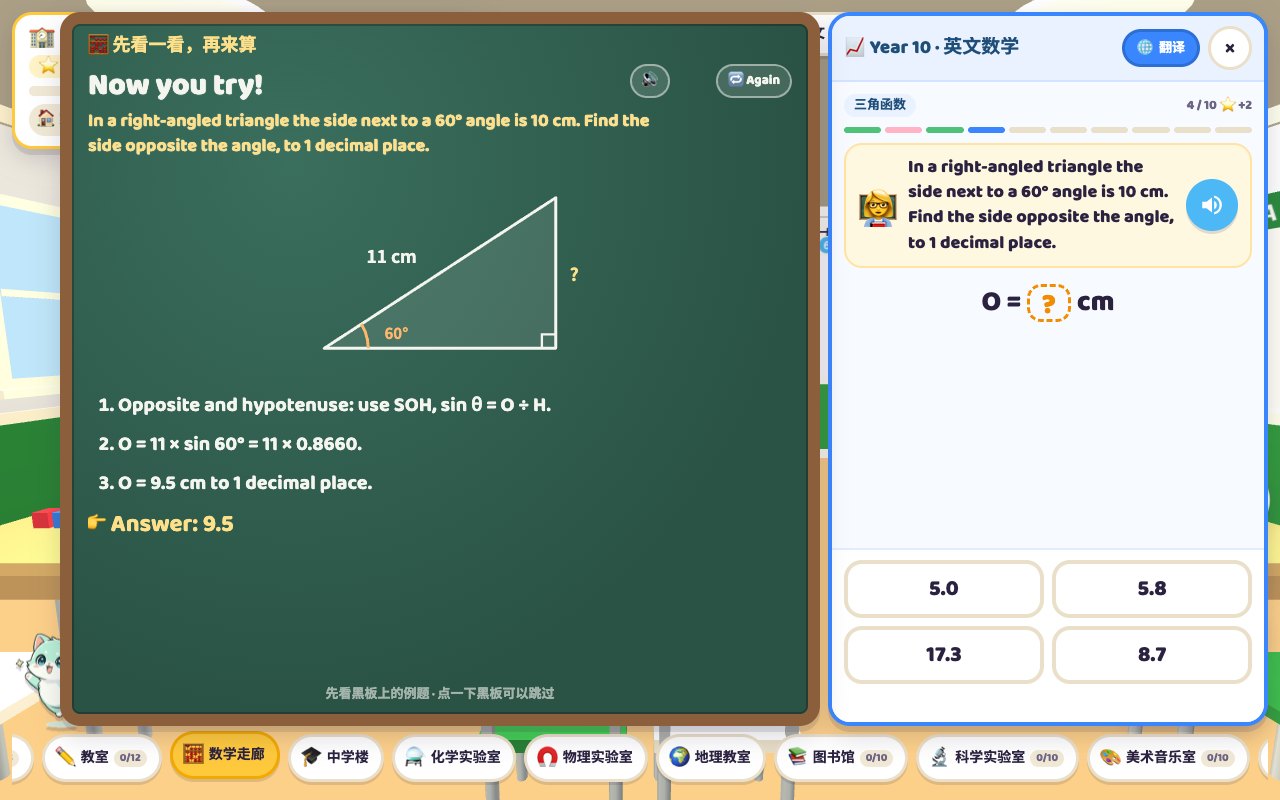
The maths corridor in Word World now has Year 3 to Year 11 rooms: five topics per year, 45 in all, from 3-digit sums and times tables to Pythagoras, trigonometry, the quadratic formula and differentiation, all in English and read aloud. Each question starts with a worked example on the blackboard, wrong choices come from common mistakes, and every question gets full English steps, a diagram and a method tip at the end. Year 10 and 11 follow common IGCSE topics; unofficial. Free; needs a free GachaLex account.
Until now the school in Word World had two maths rooms, Year 1 and Year 2, for adding and taking away within 10 and 20. Plenty of parents asked about older children, so the whole range is now in place: a maths corridor with 11 rooms, Year 1 to Year 11. From Year 3 up, each room has five topics, all in English and read aloud.
1. One corridor, eleven rooms
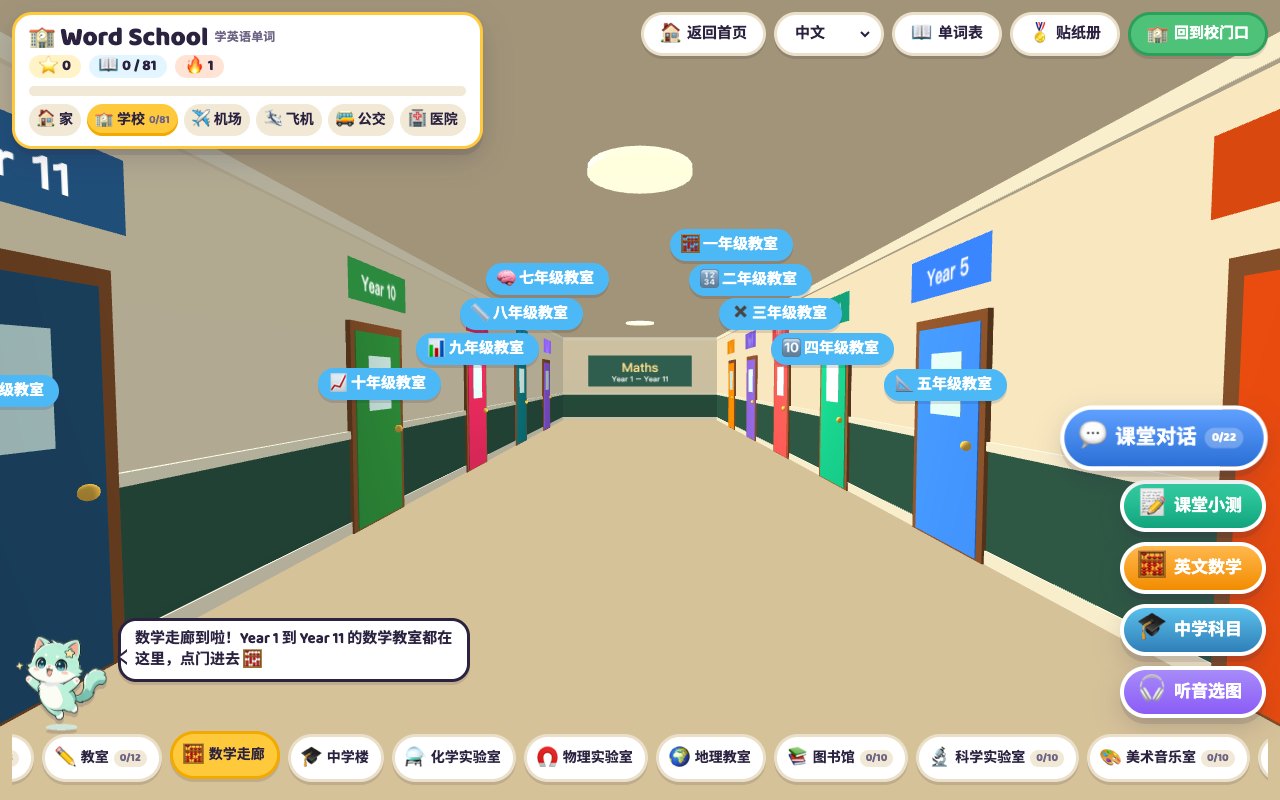
Open Word School, go into the hallway and take the Maths corridor door on the south wall (it is also in the room bar at the bottom). The six doors on the north side are Year 1 to Year 6 and the five on the south side are Year 7 to Year 11, each with a year sign. Walk into a room, then tap the blackboard or the Maths button to start a round.
Each room is dressed for its year: times tables in Year 3, BIDMAS in Year 6, Pythagoras in Year 9, SOH CAH TOA in Year 10 and the quadratic formula in Year 11. After a round there is a button for the next year and a picker for any other year.
2. What each year practises
Years follow the UK system and topics follow what is usually taught in each year, with Year 10 and Year 11 leaning towards common IGCSE Maths (Extended) questions. A round has 10 questions, two from each of five topics:
| Year | Five topics |
|---|---|
| Year 3 | Adding and subtracting 3-digit numbers, times tables, division, unit fractions of amounts |
| Year 4 | Times tables to 12 × 12, 2-digit × 1-digit, dividing by 1 digit, rounding, fractions of amounts |
| Year 5 | 2-digit × 2-digit, decimals, simple percentages, squares and cubes, adding fractions |
| Year 6 | Order of operations, percentages, sharing in a ratio, substitution, area |
| Year 7 | Negative numbers, solving equations, fractions with different denominators, angles, the mean |
| Year 8 | Equations with brackets, percentage change, indices, circles, nth term |
| Year 9 | Pythagoras, unknowns on both sides, probability, angles in polygons, standard form |
| Year 10 | Simultaneous equations, quadratics by factorising, trigonometry, gradient, compound interest |
| Year 11 | The quadratic formula, composite and inverse functions, the cosine rule, volume, differentiation |
Questions are generated fresh each time with new numbers and contexts, and none repeat within a round. Where rounding is needed the question says to 1 decimal place, to 2 decimal places or to the nearest whole number, exactly as exam papers do.
3. A worked example first, then your turn
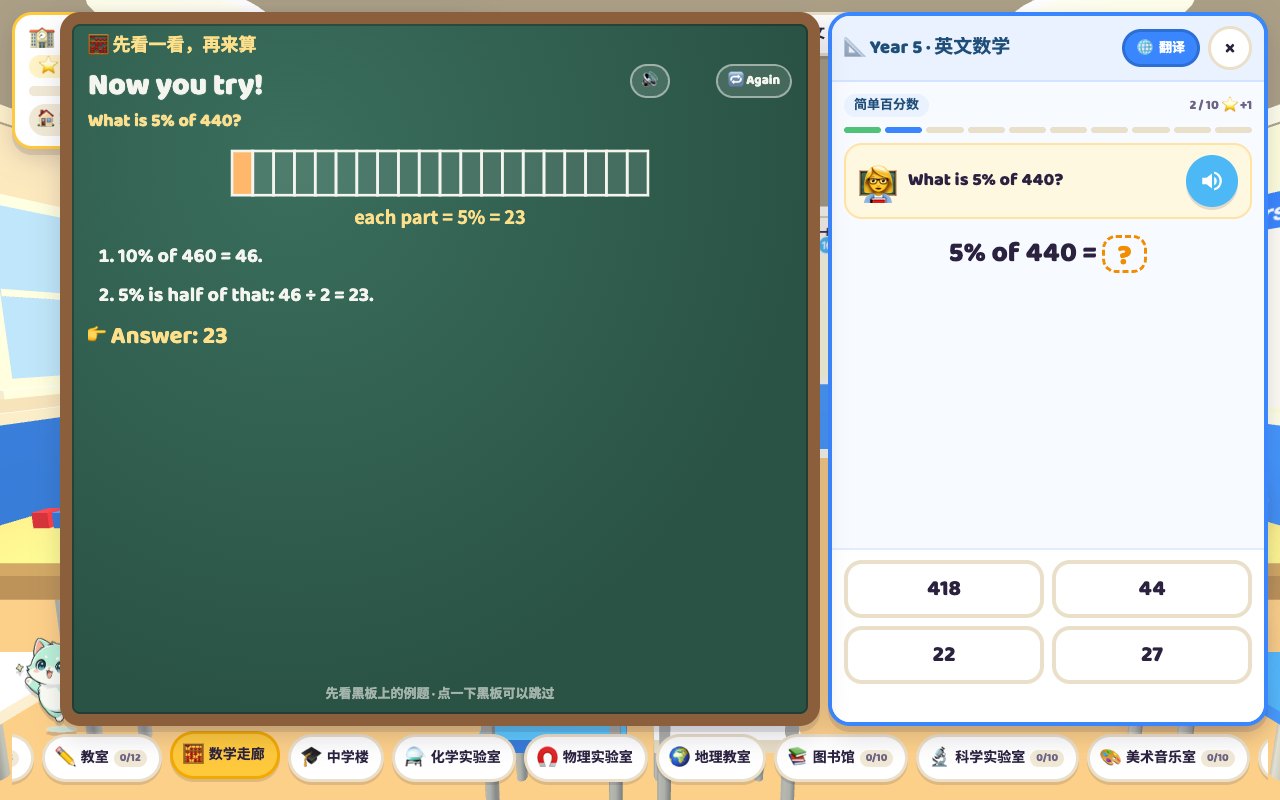
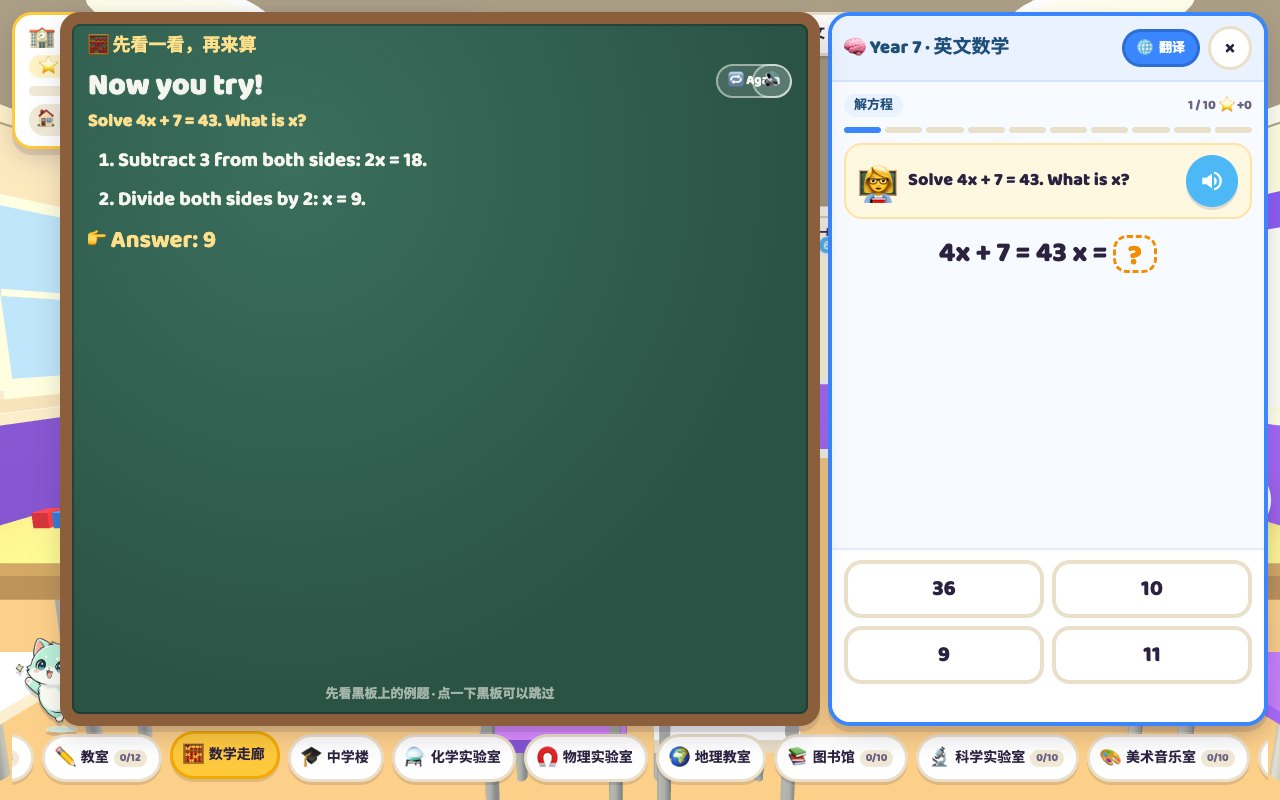
As in Year 1 and Year 2, a question does not start with the choices. After it is read out, the blackboard on the left shows an example of the same kind with different numbers and writes the method out in chalk, line by line, ending with the answer and Now you try! Only then do the choices unlock.
Where a picture helps, the board draws it first: dot arrays for multiplication and squares, bars split into parts for fractions and percentages, jumps on a number line for negatives, an area model for long multiplication, a labelled right-angled triangle for Pythagoras and trigonometry, a general triangle for the cosine rule, and a circle with its radius. The speaker button reads the whole example aloud, and a tap on the board skips it.
In Year 7 the board might show Solve 2x − 5 = 17: Add 5 to both sides: 2x = 22. Divide both sides by 2: x = 11. The child then solves 3x + 4 = 19. The numbers change but the steps are identical, so each question is a guided copy of the example.
4. Wrong choices are real mistakes
Each question has four choices, and the wrong ones are the mistakes children actually make:
- finding a² + b² in Pythagoras and forgetting the square root;
- swapping the two shares in a ratio;
- multiplying the indices instead of adding them;
- working out only the increase in a percentage change;
- picking the wrong one of sin, cos and tan;
- adding the tops and the bottoms of two fractions.
A wrong choice does not reveal the answer, but only a first-try answer earns a star. An equal value written another way, such as 1/2 and 2/4, never appears as a wrong choice.
5. After the round: full steps for every question
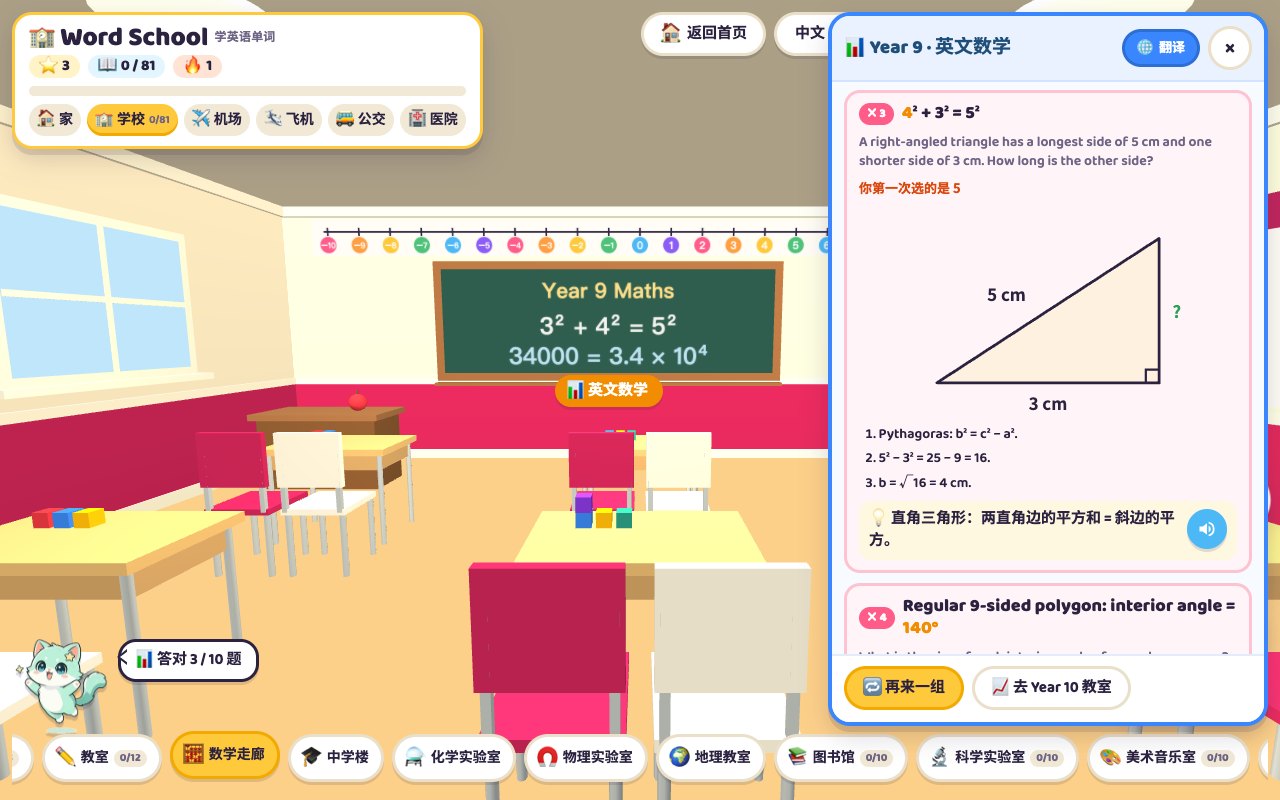
When the ten questions are done, the results screen lists them again, marks wrong ones in red and shows the first answer chosen. Each question has:
- the question and the sum with its answer;
- a diagram where the topic has one;
- the method in English, step by step, with a speaker button;
- a one-line method tip, such as Same base: multiply → add powers.
The English steps are what a child needs to read and write at school. On the Chinese, Japanese, Korean and Thai pages the tip is in that language, for children and parents to compare.
6. Year 10, Year 11 and IGCSE
The Year 10 and Year 11 topics are chosen from common IGCSE Maths questions: simultaneous equations, quadratics, trigonometry, compound interest, the quadratic formula, functions, the cosine rule, volume and differentiation. Each question practises the standard method for one skill, which makes it a quick revision pass before exams, not a replacement for past papers.
Note: these are Word World's own practice questions. They are not official material and have no connection with Cambridge International or the IGCSE examinations.
7. How to use it
- Start a year below: a child new to an English-medium school can begin one year down and move up once the wording feels easy.
- One round a day, about ten minutes, including the example and the steps at the end.
- Talk through the red ones: have the child read the steps out in English.
- Pair it with words and talking: the School scene's classroom dialogues include a maths lesson.
The maths corridor is part of the School scene: free, with a free GachaLex account needed to play, and it works in any phone or computer browser. For how the six scenes fit together, see the Word World overview.
Frequently asked questions
How many topics are there from Year 3 to Year 11?
45: five per year, from 3-digit sums and times tables to Pythagoras, trigonometry, the quadratic formula and differentiation. A round has 10 questions, two from each topic, generated fresh each time.
How is each question taught?
After the question is read out, the blackboard works through an example of the same kind with different numbers, step by step and with a diagram where useful, before the choices unlock. After the round every question gets full English steps, a diagram and a method tip.
Can Year 10 and Year 11 help with IGCSE?
They are useful for revising the standard method for common topics such as simultaneous equations, quadratics, trigonometry, the cosine rule and differentiation, but not as a replacement for past papers. These are Word World's own questions, with no connection to Cambridge International or the IGCSE examinations.
Is it free?
Yes, it is free, but it needs a free GachaLex account because the maths corridor sits in the School scene; only Home works without logging in. It works in phone and computer browsers, and the interface comes in English, Chinese, Japanese, Korean and Thai. The questions themselves are in English.