
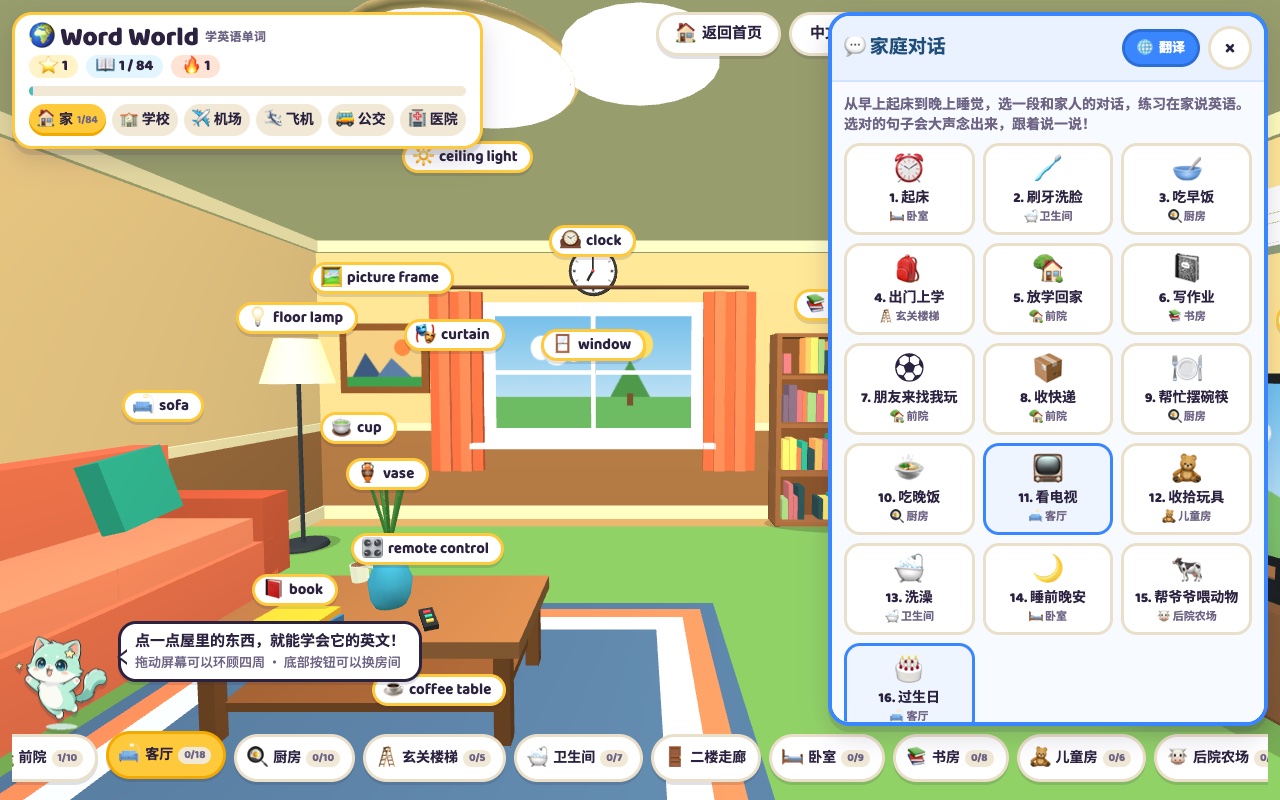
Word World added 38 English dialogues for children to its Home and School scenes. The 16 at home follow a day: waking up, brushing teeth, breakfast, leaving for school, coming home, homework, a friend at the door, a parcel, setting the table, dinner, TV, tidying up, bath time and bedtime, plus feeding farm animals and a birthday. The 22 at school cover lessons, talking to teachers and talking to classmates, with a class quiz. Each step asks for the best of three replies. Free; Home needs no login and School needs a free account.
My child has been at an international school for over a year. The vocabulary has grown fast, but speaking still stalls: when I ask in the morning whether he has brushed his teeth, he knows brush and teeth but cannot put a full answer together. Until now the Home and School scenes in Word World only taught words. This update gives each of them a set of dialogues, so the words turn into sentences a child can actually say.
1. How it works: they speak, you pick one of three replies
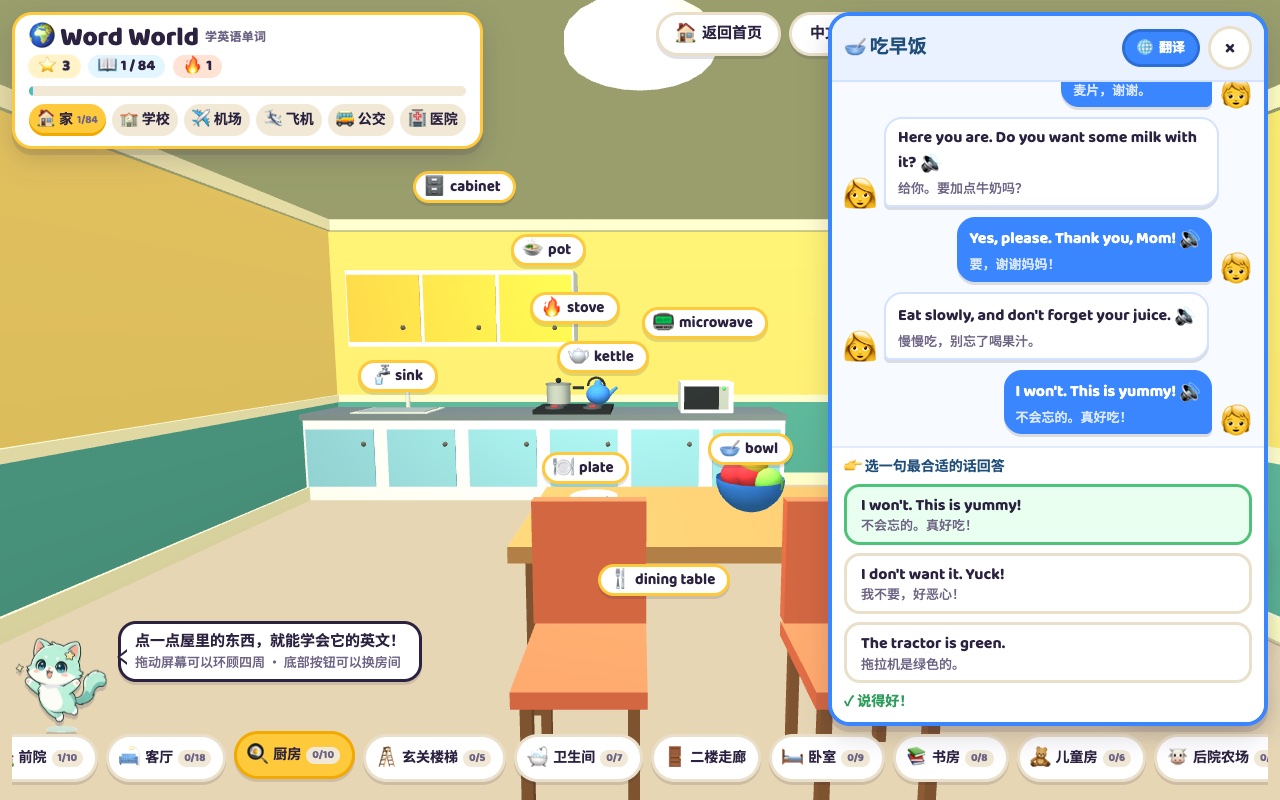
At Home, tap Home talk; at School, tap Class talk, then choose a dialogue. The other person (Mom, Dad, a teacher or a classmate) says a line and the child picks the best reply from three. Only one is right. Of the other two, one is rude and one is off-topic:
- a rude choice (answering Mom's wake-up call with Go away! I'm sleeping.) asks the child to try a politer way;
- an off-topic one (answering a breakfast question with I sleep on my pillow.) asks the child to listen again.
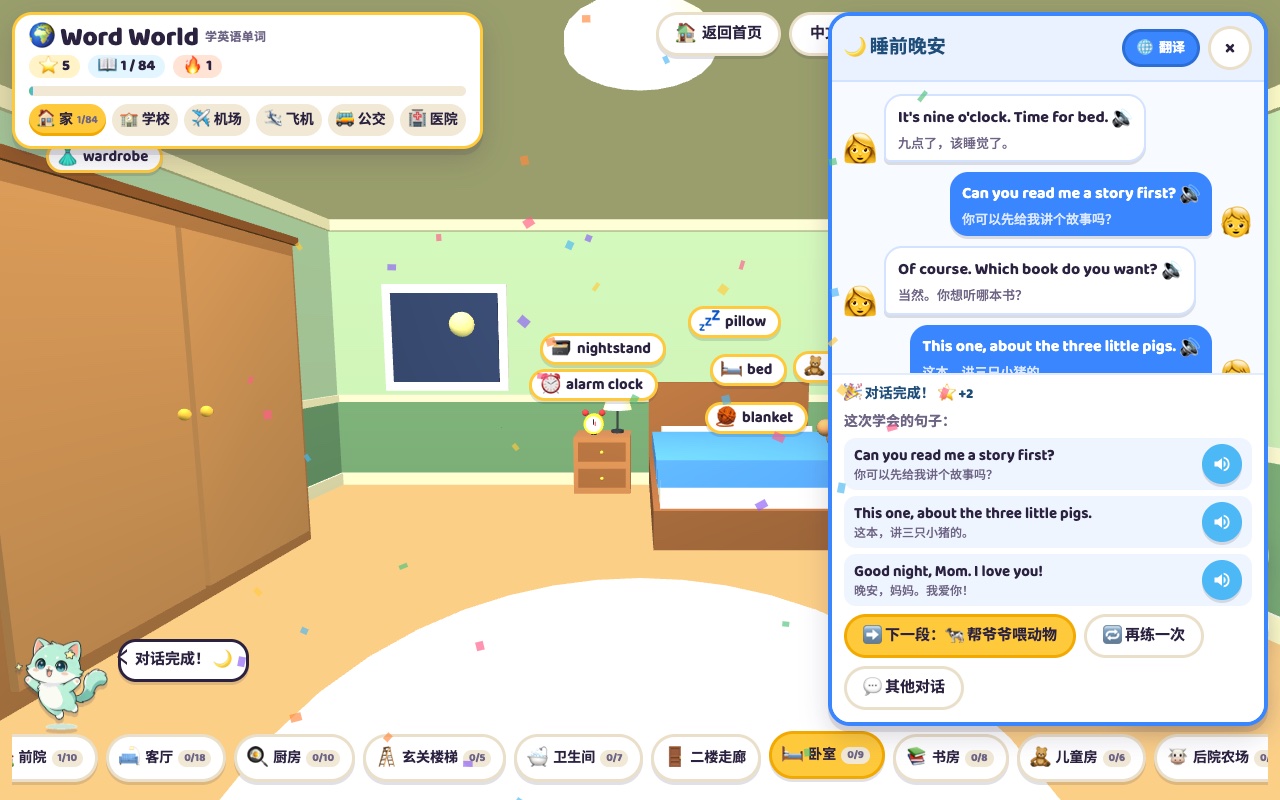
The right reply is read out loud so the child can repeat it. On the Chinese, Japanese, Korean and Thai pages every line has a translation that can be switched off. A first-try answer earns a star, and finishing a dialogue for the first time adds two more. At the end the child sees the sentences they learned, with a speaker button for each, and a Next button leads to the following dialogue.
2. Sixteen dialogues at home, from waking up to bedtime
The home dialogues are numbered in the order of a day. Start at number 1 and keep pressing Next to go through a child's whole day:
| Time | Dialogues | Room |
|---|---|---|
| Morning | 1. Wake up 2. Brush and wash 3. Breakfast 4. Off to school | Bedroom, bathroom, kitchen, hall |
| Afternoon | 5. Back home 6. Homework 7. Play with a friend 8. A package | Front yard, study |
| Early evening | 9. Set the table 10. Dinner time 11. Watch TV | Kitchen, living room |
| Night | 12. Tidy up 13. Bath time 14. Bedtime | Kids' room, bathroom, bedroom |
| Weekends and special days | 15. Feed the animals 16. Birthday | Farm, living room |
Choosing a dialogue walks the camera to its room first. Word cards are a way in too: tap the alarm clock, toothbrush, backpack, remote, toy box or cow and a Chat button appears on the card that opens the matching dialogue.
3. Lines worth repeating
The home lines are short, and they are exactly the ones children need every day and often say only halfway:
- Answering a parent: Not yet. I'm doing it now., OK, Mom. I'll be quick., Coming! I'm putting on my shoes.
- Asking politely: Cereal, please., Yes, please. Just a little., A little. Can I have a snack, please?
- Sorry and thank you: Sorry, Mom. I'll clean it up., Thank you for the yummy dinner!, Thanks for coming!
- Making a request: Can we watch cartoons, please?, Can you read me a story first?, Can I bring my rubber duck?
The wrong choices are fun too: Whatever. Just give me food., You do it for me! and Pay me first. are all things children really say. My child laughs when he picks one, and it is a good moment to ask how Mom would feel hearing it.
In number 8 the courier opens with Is your mom or dad at home?, and the right answer is Yes, my mom is home. Just a moment, please. In other words, fetch an adult instead of opening up and taking the parcel alone. In a house abroad, that is worth a separate talk with your child.
4. Twenty-two dialogues at school: lessons, teachers and classmates
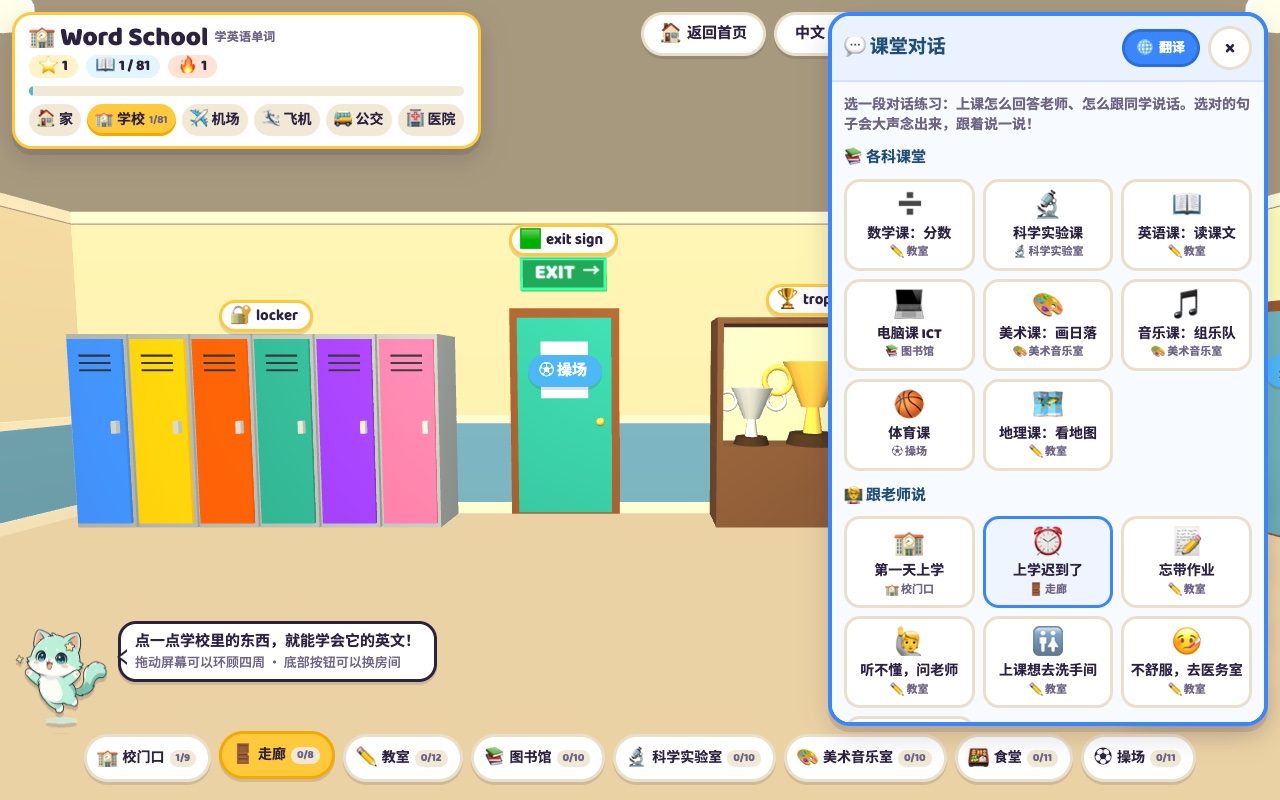
The school dialogues come in three groups, chosen from the situations children meet most often at an international school:
| Group | Dialogues |
|---|---|
| Lessons (8) | Maths: fractions, a science experiment, English: reading aloud, ICT, Art: painting a sunset, Music: forming a band, PE, Geography: reading a map |
| Talking to teachers (7) | First day at school, late for school, forgot my homework, asking when you don't understand, needing the toilet in class, feeling unwell, borrowing a library book |
| Talking to classmates (7) | Making a new friend, borrowing stationery, group work, lunch together, playing at break, bumping into someone and saying sorry, revising before a test |
For a child who has just changed schools, the teacher group is often the most useful: how to explain being late, how to say the homework is at home, how to ask to go to the toilet, how to ask the teacher to explain again. The School scene also has a Class quiz covering classroom instructions, subject knowledge, polite expressions and grammar gaps, which works well as a check after the dialogues.
5. How the dialogues fit with the words
Many lines use words from the same rooms: the breakfast dialogue has bowl and sink, Off to school has backpack and umbrella, and Homework has desk and lamp. What works for us is tapping through the words in a room first and then opening that room's dialogue, so the words show up in a sentence straight away.
Word World has six scenes, and the others have dialogues too: 13 conversations with the cabin crew, a complete bus ride and 21 dialogues at the hospital. With these 38, most everyday situations are covered.
6. How to fit it in
- Follow the real day: play 1 to 4 before leaving in the morning, 5 to 8 after school, and 13 and 14 before bed, then say them again for real.
- Practise the teacher group before term starts: the 7 dialogues take about 15 minutes; focus on being late, forgotten homework, the toilet and feeling unwell.
- Do not rush to correct a wrong choice: let the child read the hint and try again. Stars only come for a first-try answer, and children notice.
Home and School are both free: Home needs no login, School needs a free account, and both run in the browser on phones and computers. For how the six scenes fit together, see the Word World overview.
Frequently asked questions
How many dialogues are there at Home and School?
38 in total: 16 at home, in the order of a day from waking up to bedtime, and 22 at school, split into 8 lessons, 7 with teachers and 7 with classmates. The School scene also has a Class quiz.
What happens after a wrong answer?
The answer is not revealed. A rude choice asks for a politer way, an off-topic one asks the child to listen again, and the child can choose again. Stars come only for a first-try answer.
Are there translations?
On the Chinese, Japanese, Korean and Thai pages every line has a translation that can be switched off. The English page shows no translations.
What age is it for?
It is designed for ages 6–12 and suits children who have just joined an international school and need English at home and in class. It is free; Home needs no login and School needs a free account.