
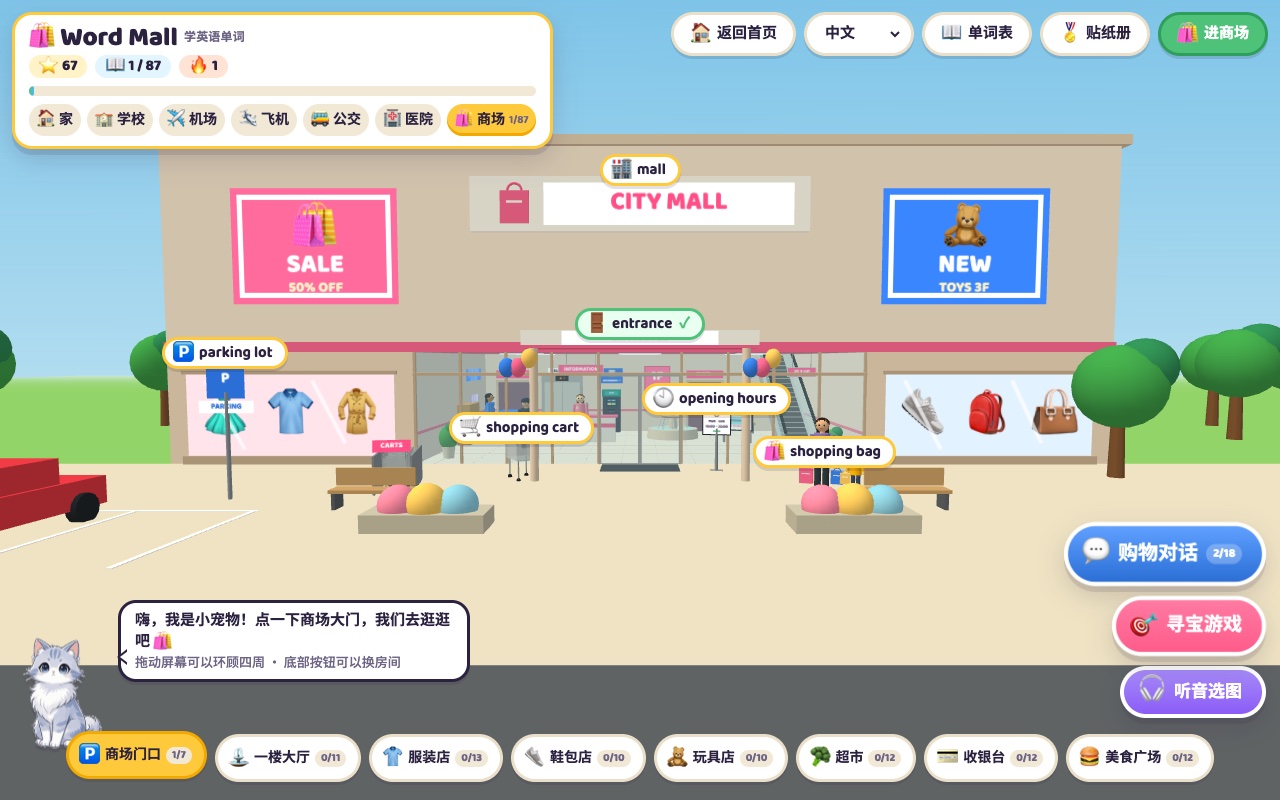
The new Mall scene in Word World has 87 shopping English words in 8 areas and 18 numbered dialogues for children in the order of a trip to the mall: asking the way, just looking, sizes, trying on, a sale, shoes and a school backpack, asking the price, a present, finding things in the supermarket, weighing fruit, a free sample, paying in cash and getting change, a card and a coupon, ordering food, ice cream, returning a broken toy and what to do if you get lost. Each step asks for the best of three replies, read aloud, with translations. Free; needs a free GachaLex account.
On weekend trips to the mall, the thing my child most wants to do alone is buy something: choose it, ask the price, hand over the money. But in an English-speaking shop, a single Can I help you? from the assistant can send him behind my back. The Mall in Word World lets children walk the whole route on screen first: asking the way, trying things on, asking prices, paying and getting change, and returning a broken toy.
1. Eight areas, 87 words
| Area | Words | Examples |
|---|---|---|
| Mall entrance | 7 | mall, entrance, parking lot, shopping cart, opening hours |
| Atrium | 11 | information desk, directory, escalator, elevator, lost and found |
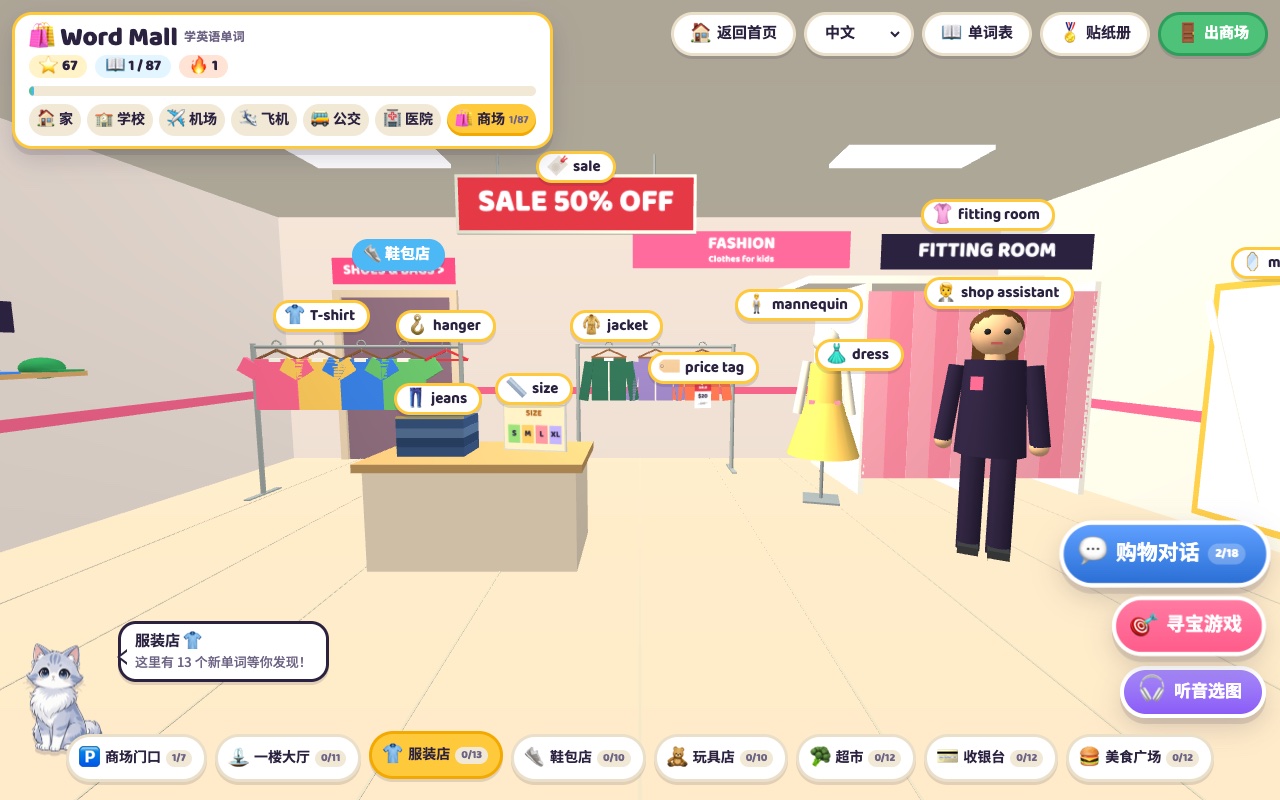
| Clothing store | 13 | T-shirt, jacket, fitting room, mirror, price tag, size, sale |
| Shoes and bags | 10 | sneakers, boots, sandals, shoe box, backpack, wallet |
| Toy store | 10 | teddy bear, robot, puzzle, board game, kite, gift wrap |
| Supermarket | 12 | basket, aisle, shelf, scale, frozen food, free sample |
| Checkout | 12 | cashier, barcode, receipt, change, coupon, self-checkout |
| Food court | 12 | food court, menu, tray, fries, napkin, takeaway |
A few words deserve a second look: the s in aisle is silent, so it sounds like I'll; the p in receipt is silent; and the American first floor is the British ground floor. The word cards point these out in their tips.
2. Eighteen numbered dialogues in the order of a shopping trip
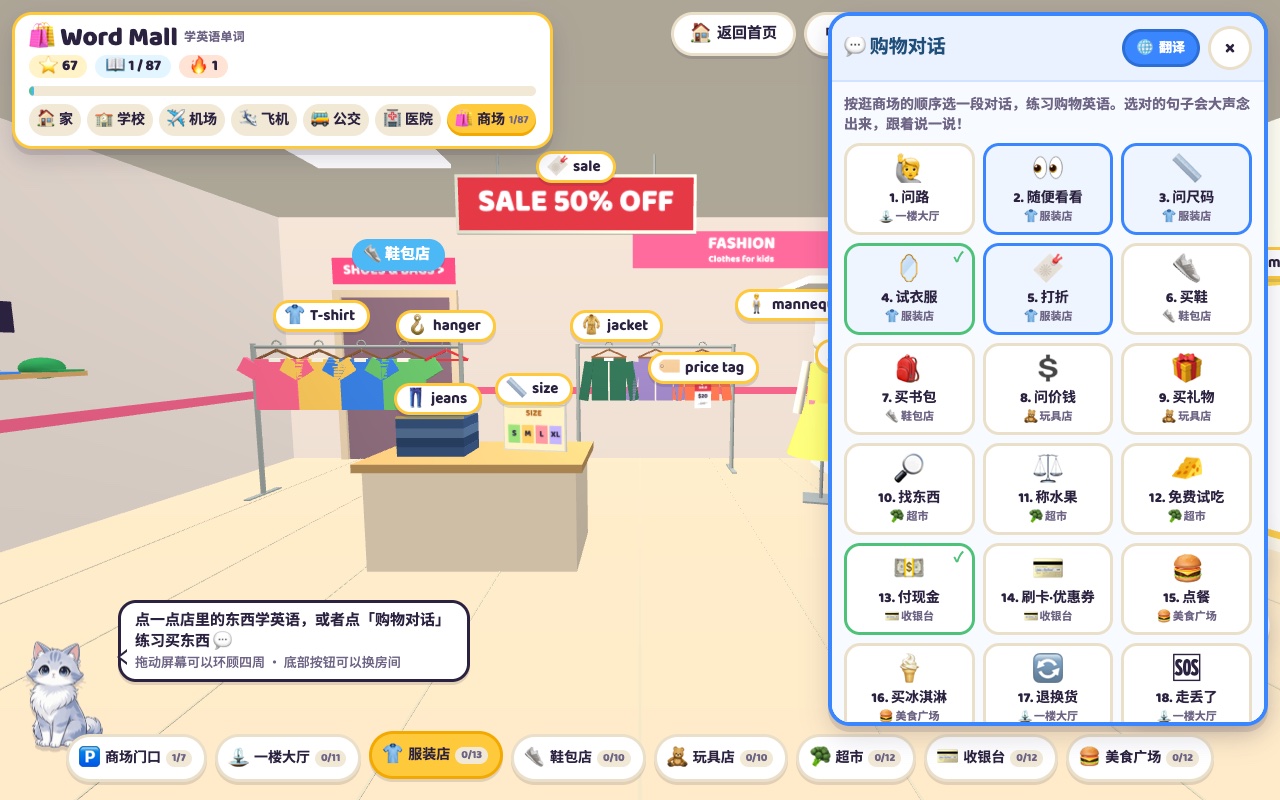
Tap Shopping talk and the dialogues appear numbered along a real route through the mall:
| Place | Dialogues |
|---|---|
| Atrium | 1. Asking the way |
| Clothing store | 2. Just looking 3. What size? 4. Trying it on 5. A sale |
| Shoes and bags | 6. Buying shoes 7. A school backpack |
| Toy store | 8. How much is it? 9. Buying a present |
| Supermarket | 10. Finding things 11. Weighing fruit 12. A free sample |
| Checkout | 13. Paying in cash 14. Card and coupon |
| Food court | 15. Ordering food 16. Ice cream |
| Returns and safety | 17. Returning a toy 18. Lost in the mall |
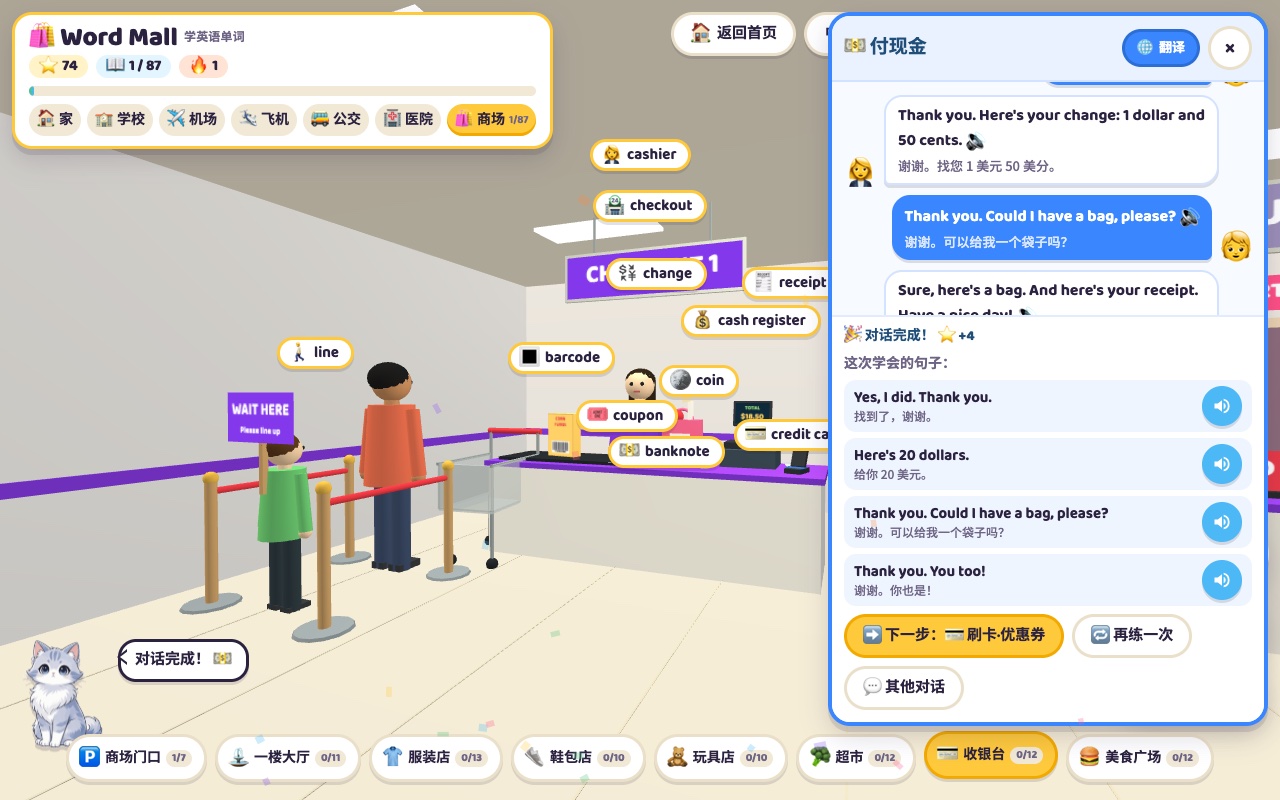
Each dialogue ends with a Next button that opens the following one. If the child is in a different shop, tapping a dialogue walks there first. After paying in cash a shopping bag appears on the counter, and after ordering a burger meal appears on the table.
3. The lines worth learning first
- Not ready to buy: when the assistant asks Can I help you?, I'm just looking, thank you. is far politer than shaking your head and walking off.
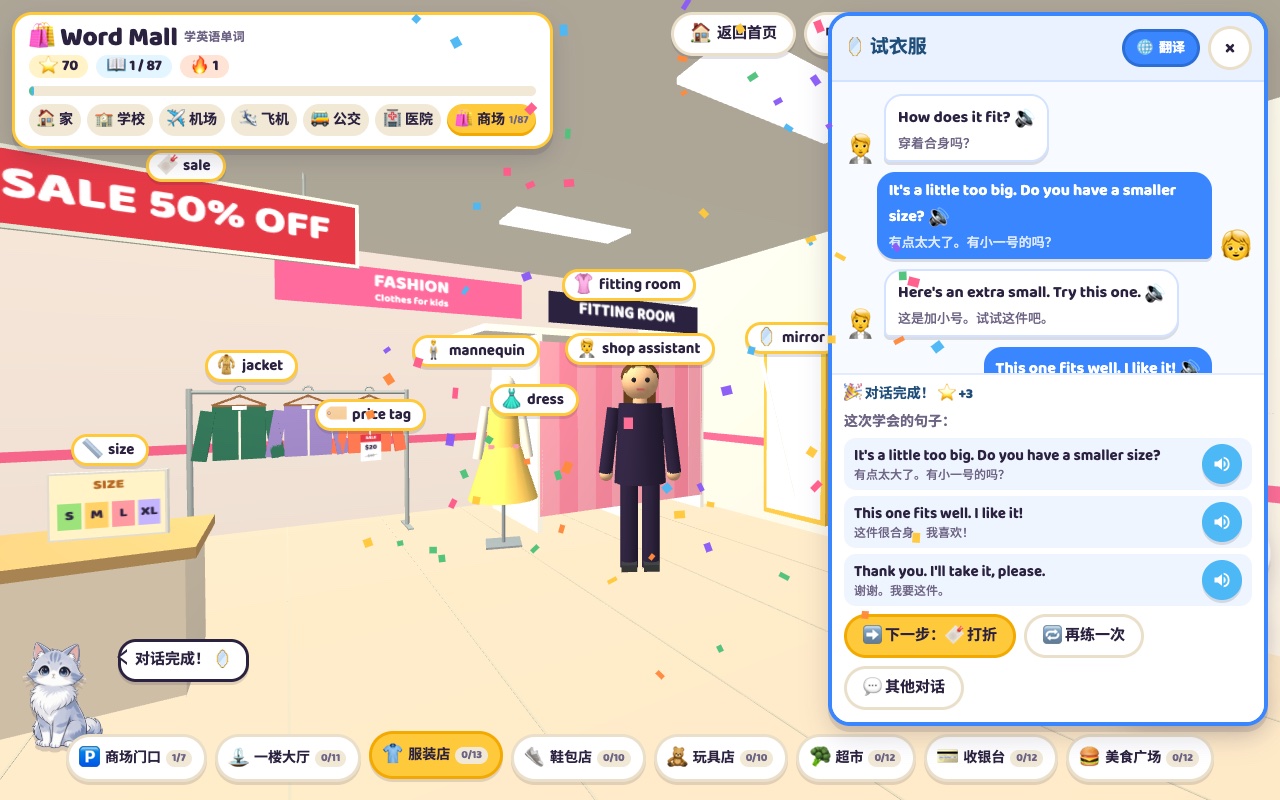
- Colours and sizes: Do you have this T-shirt in blue?, I'm not sure. Maybe a small?, It's a little too big. Do you have a smaller size?
- Trying on: Can I try it on, please? — and the answer The fitting room is over there, on the right.
- Prices: How much is it, please? If it is too much, say That's too expensive for me. Do you have a cheaper one? rather than That's crazy!
- In the supermarket: Where can I find the milk, please?, and understanding It's in the fridge at the back, next to the eggs.
- Ordering food: Can I have a cheeseburger and fries, please?, then understanding For here or to go? and answering For here, please.
4. Practise money along the way
The numbers in the dialogues add up, so you can pause and let the child work them out:
| Dialogue | What the assistant says | Ask the child |
|---|---|---|
| 5. A sale | It was 40 dollars, and it is 50% off today | What does it cost now? (20 dollars) |
| 8. How much is it? | The big robot is 30 dollars, the small one is 12 | With 15 dollars, which can you buy, and what is left? |
| 13. Paying in cash | The total is 18 dollars 50 cents; you pay with 20 | How much change? (1 dollar 50 cents) |
| 14. Card and coupon | The total is 30 dollars; the coupon takes off 5 | What do you pay? (25 dollars) |
Number 13 is my child's favourite: when the cashier says Here's your change, he works it out first and then checks.
5. The last dialogue: lost in the mall
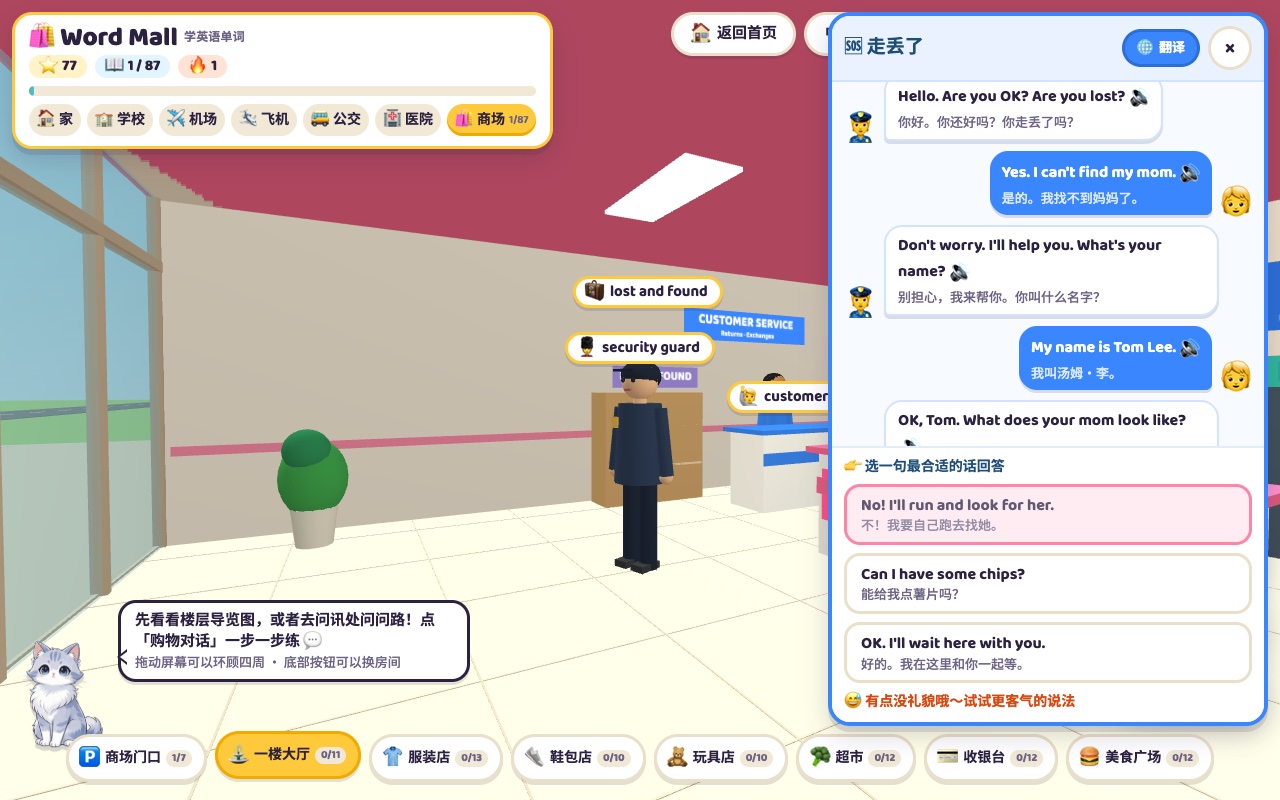
Dialogue 18 starts with a security guard asking Are you lost? The child says I can't find my mom., gives their name and describes her: She has long black hair. She's wearing a red dress. The guard replies Let's wait here at the information desk. We'll make an announcement for her. The wrong choice at this step is No! I'll run and look for her., and picking it asks the child to try again.
Before a trip, agree with your child: if we get separated, do not run around. Stay where you are, or go to the information desk, a security guard in uniform or a cashier. Make sure the child knows a parent's phone number and what you are wearing that day; that matters more than any English sentence.
6. Feedback for wrong answers, and how to fit it in
As in the Hospital and on the Plane, every step offers three replies and a wrong one does not reveal the answer. A rude choice, such as Give it to me!, asks for a politer way; an off-topic one, such as I like trains., asks the child to listen again. A first-try answer earns a star, and finishing a dialogue for the first time adds two more.
- Play numbers 1 to 9 with Next through the clothing store, the shoe shop and the toy store. It takes about 15 minutes.
- Then play 10 to 16: the supermarket, the checkout and the food court have the most numbers, so do the maths as you go.
- Play 17 and 18 together at a calm moment, and talk about keeping receipts for returns and what to do if you get lost.
The Mall is the seventh scene in Word World; for how the other six work, see the Word World overview.
Frequently asked questions
How many words and dialogues are in the Mall?
87 words in 8 areas and 18 dialogues numbered along a shopping trip: asking the way, the clothing store, shoes and bags, the toy store, the supermarket, the checkout and the food court, ending with a return and what to do if you get lost.
Can the dialogues be played in a row?
Yes. Each one ends with a Next button that opens the following dialogue; if the child is in another shop, the scene walks there first.
What currency do the dialogues use?
Dollars and cents, and the numbers add up, so a sale, change and a coupon can all be turned into quick sums.
What age is it for?
It is designed for ages 6–12, but asking prices, trying things on, paying and asking for help when lost are just as useful for older children and adults who travel.