
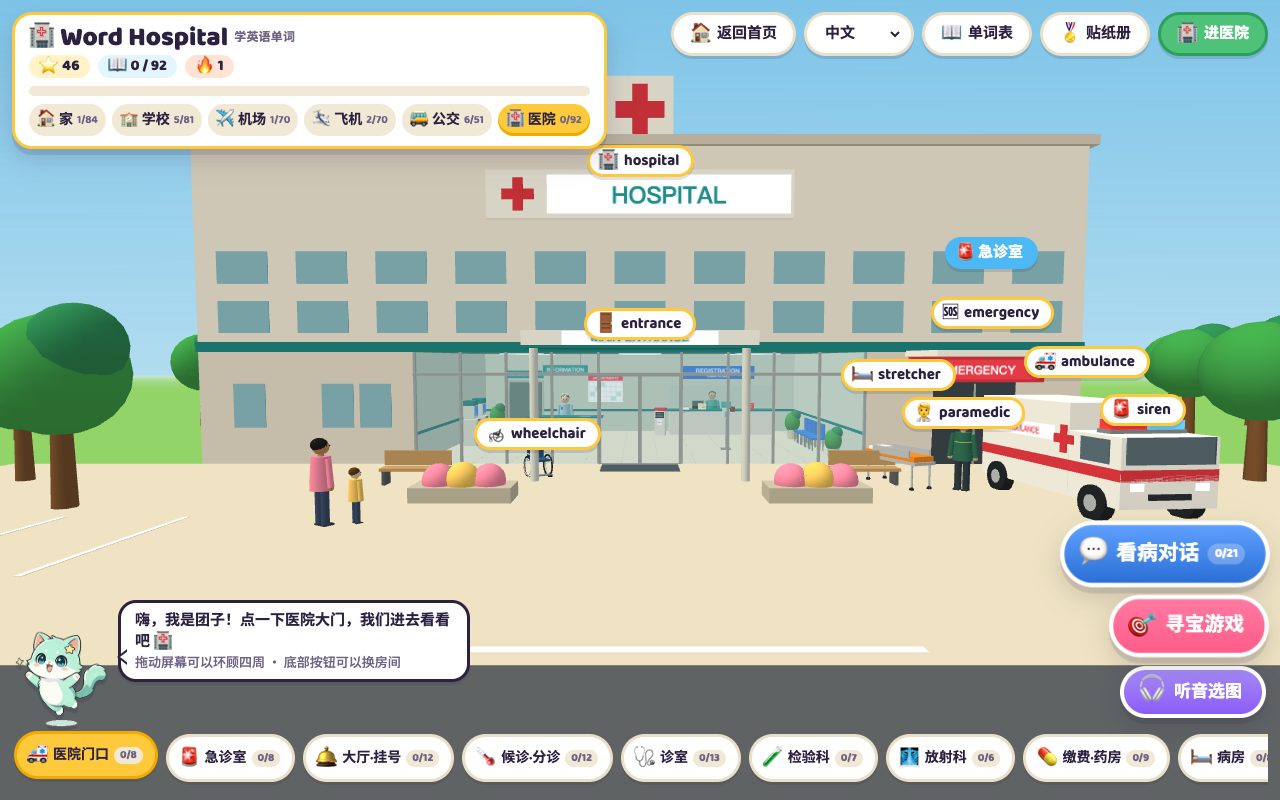
The Hospital scene in Word World has 92 words in 10 areas and 21 dialogues numbered in the order of a real visit: asking the way, a new patient file, checking in, temperature and blood pressure, waiting for your number, telling the doctor, a blood test, an X-ray, paying and medicine, plus emergencies, the ward, a vaccine, the dentist and an eye test. The medical lines are language examples, not advice.
Taking a child to a doctor abroad, the worst moment is not the queue. It is the doctor bending down to ask What's the matter? and the child not knowing how to say what is wrong. Parents can translate, but doctors want to hear it from the child. The Hospital in Word World is built for that moment, and it is the newest and largest scene in Word World.
1. Ten areas, 92 words
| Area | Words | Examples |
|---|---|---|
| Hospital entrance | 8 | hospital, ambulance, paramedic, stretcher, wheelchair |
| Emergency room | 8 | emergency, stitches, ice pack, sling, sprained ankle |
| Lobby and check-in | 12 | information desk, register, appointment, date of birth, allergy |
| Waiting and triage | 12 | waiting room, nurse, thermometer, fever, blood pressure |
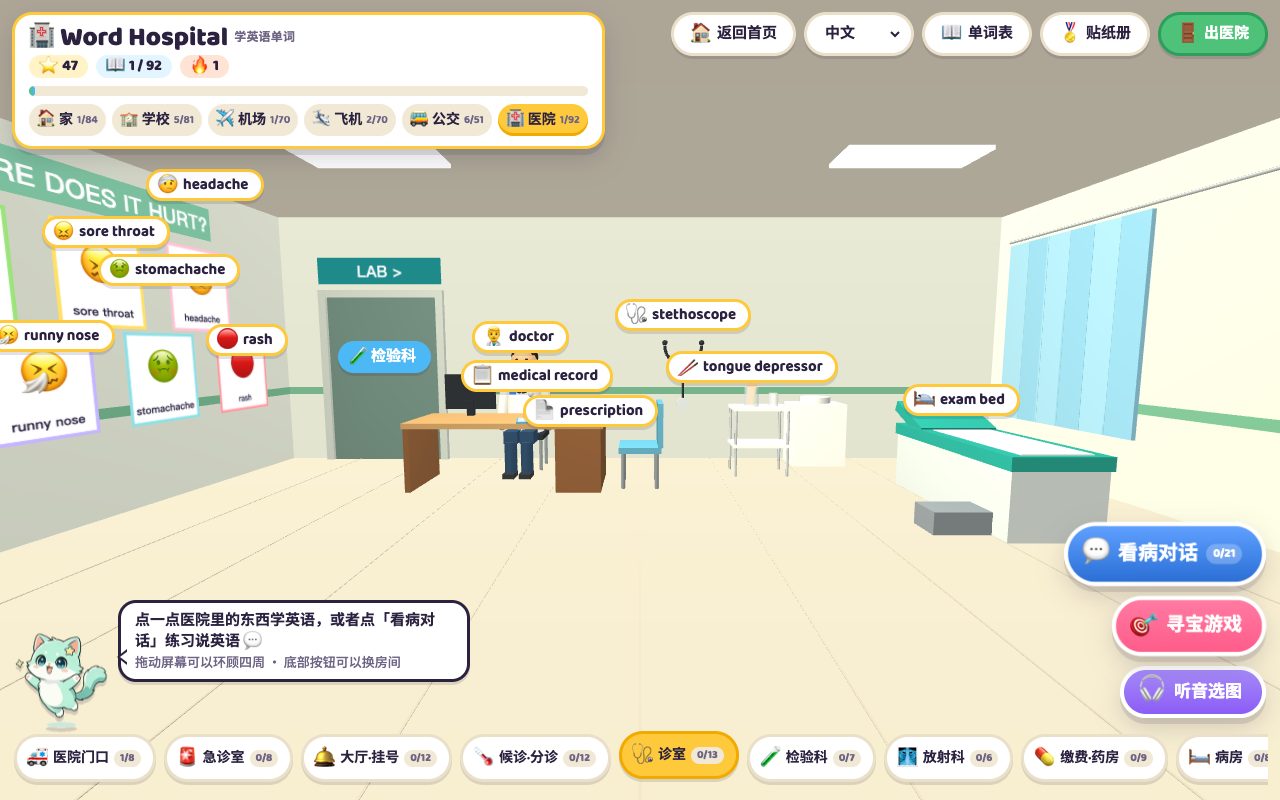
| Doctor's room | 13 | stethoscope, prescription, headache, sore throat, rash |
| Lab | 7 | blood test, needle, cotton ball, bandage |
| Radiology | 6 | X-ray, CT scan, lead apron, broken arm |
| Cashier and pharmacy | 9 | cashier, receipt, pharmacy, pill, syrup, dose |
| Ward | 8 | ward, IV drip, call button, crutches, cast |
| Pediatrics, dental and eye clinic | 9 | vaccine, dentist, toothache, eye chart, glasses |
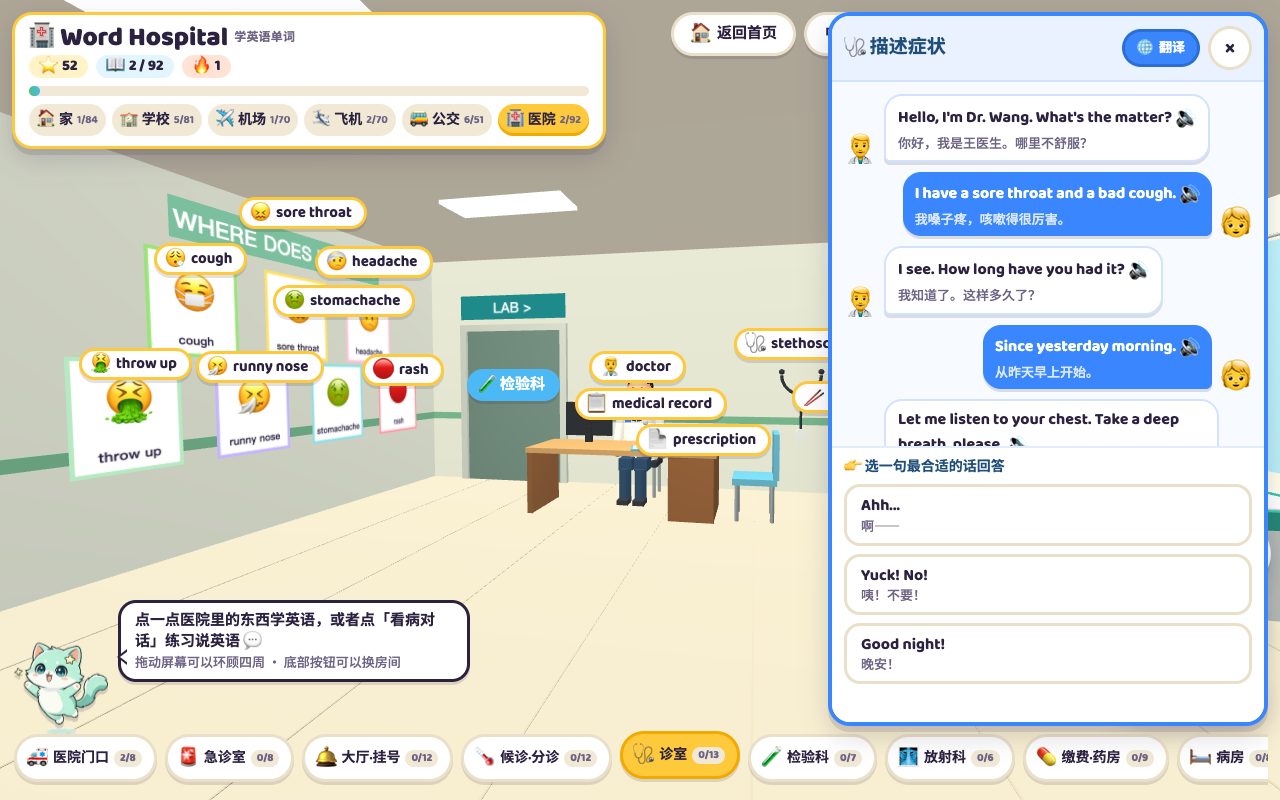
Of the 13 words in the doctor's room, headache, stomachache, sore throat, cough, runny nose, rash and throw up are all symptoms, shown on a Where does it hurt? board on the wall so the child can match each one to a part of the body.
2. Twenty-one numbered dialogues in the order of a visit
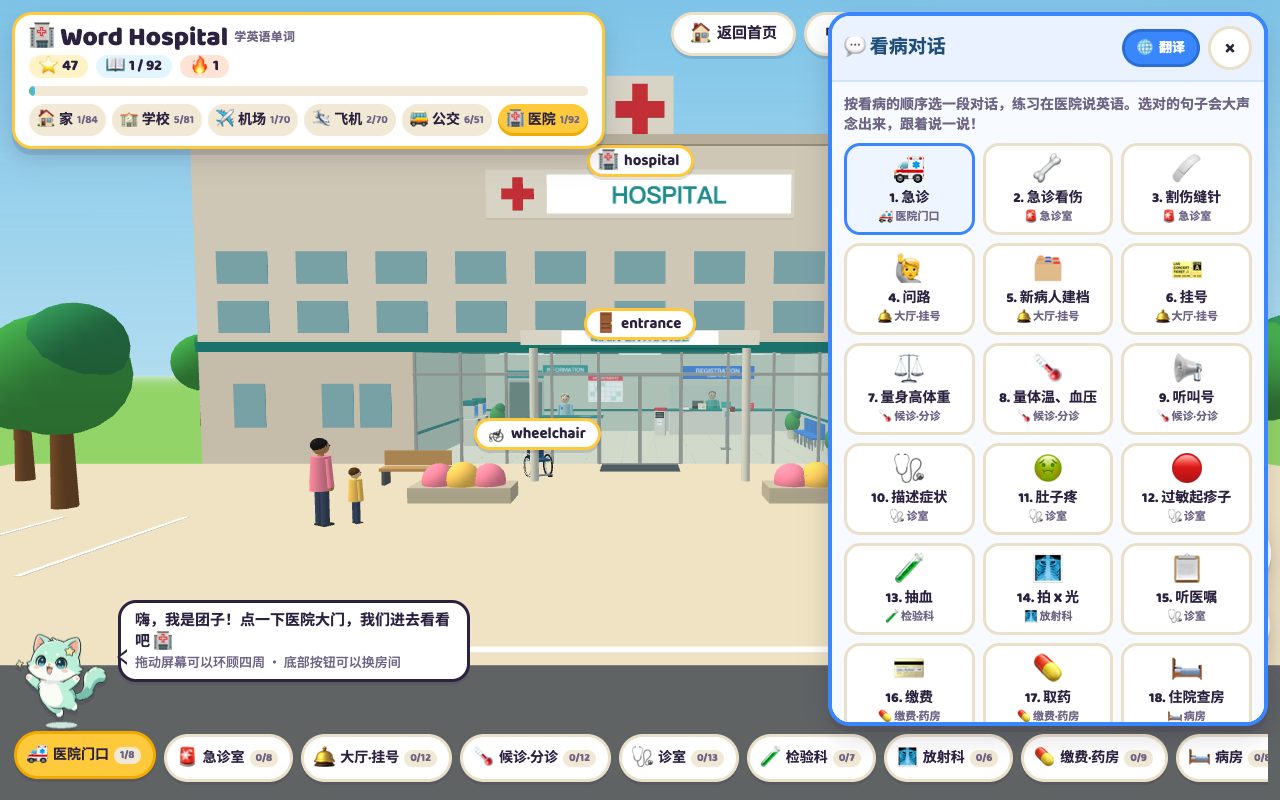
Tap Hospital talk and the dialogues appear numbered in the order of a real visit:
| Stage | Dialogues |
|---|---|
| Emergency | 1. Emergency 2. ER: a hurt arm 3. ER: a deep cut |
| Arriving and checking in | 4. Asking the way 5. New patient file 6. Checking in |
| Waiting | 7. Height and weight 8. Temperature and blood pressure 9. Waiting for your number |
| Seeing the doctor | 10. Telling the doctor 11. A tummy ache 12. An itchy rash |
| Tests | 13. Blood test 14. Getting an X-ray 15. Doctor's advice |
| Paying and medicine | 16. Paying 17. Getting medicine |
| Other departments | 18. In the ward 19. Getting a vaccine 20. At the dentist 21. Eye test |
Each dialogue ends with a Next button that leads to the following step, so Waiting for your number leads to Telling the doctor. Start at number 4 and keep going for a complete outpatient visit.
3. A whole visit, step by step
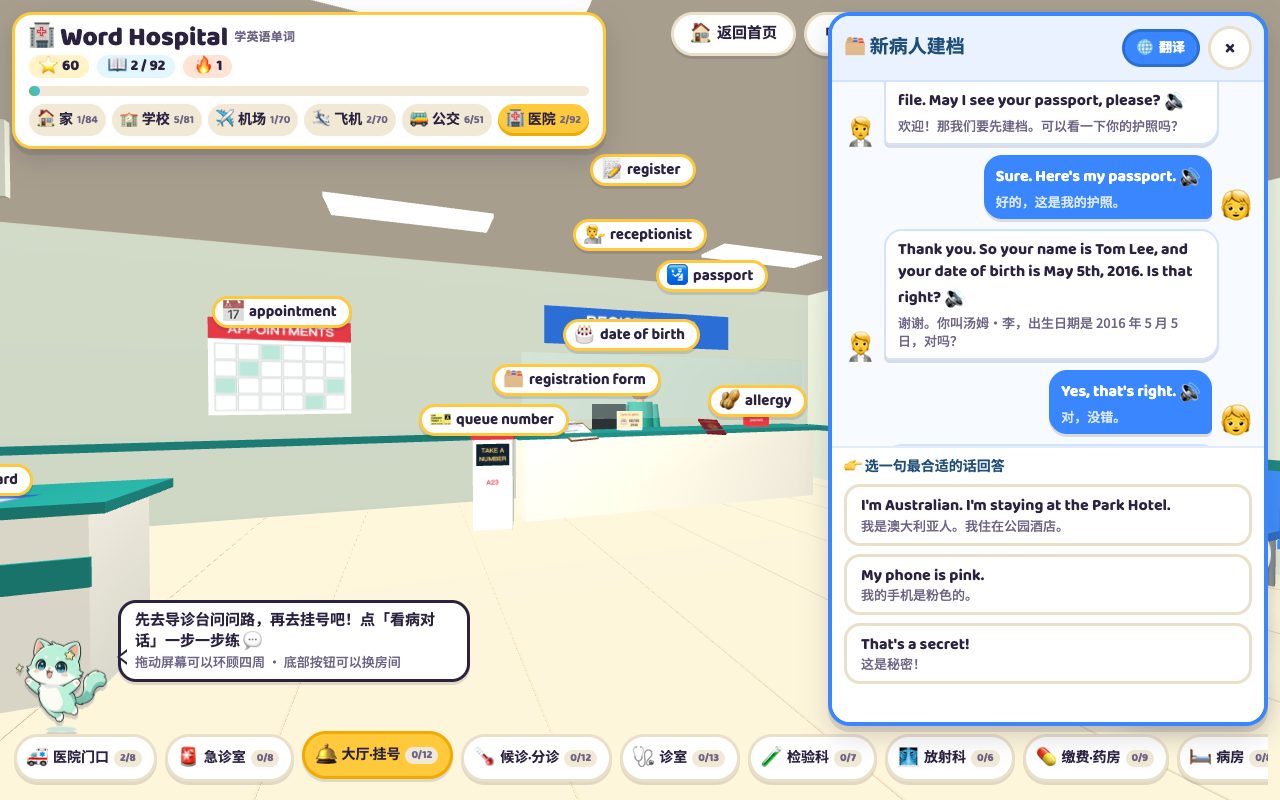
The main character, Tom Lee, is a visitor from abroad, so many lines suit families who need a doctor away from home:
- New patient file: Is this your first visit? — Yes, it's my first time here. I'm visiting from abroad. Then show a passport, confirm the date of birth, say I'm allergic to peanuts. and give an emergency contact.
- Checking in: without a local ID, say I'm a foreigner. Here's my passport.; show the travel insurance card; name the department: Pediatrics, please. I have a fever.
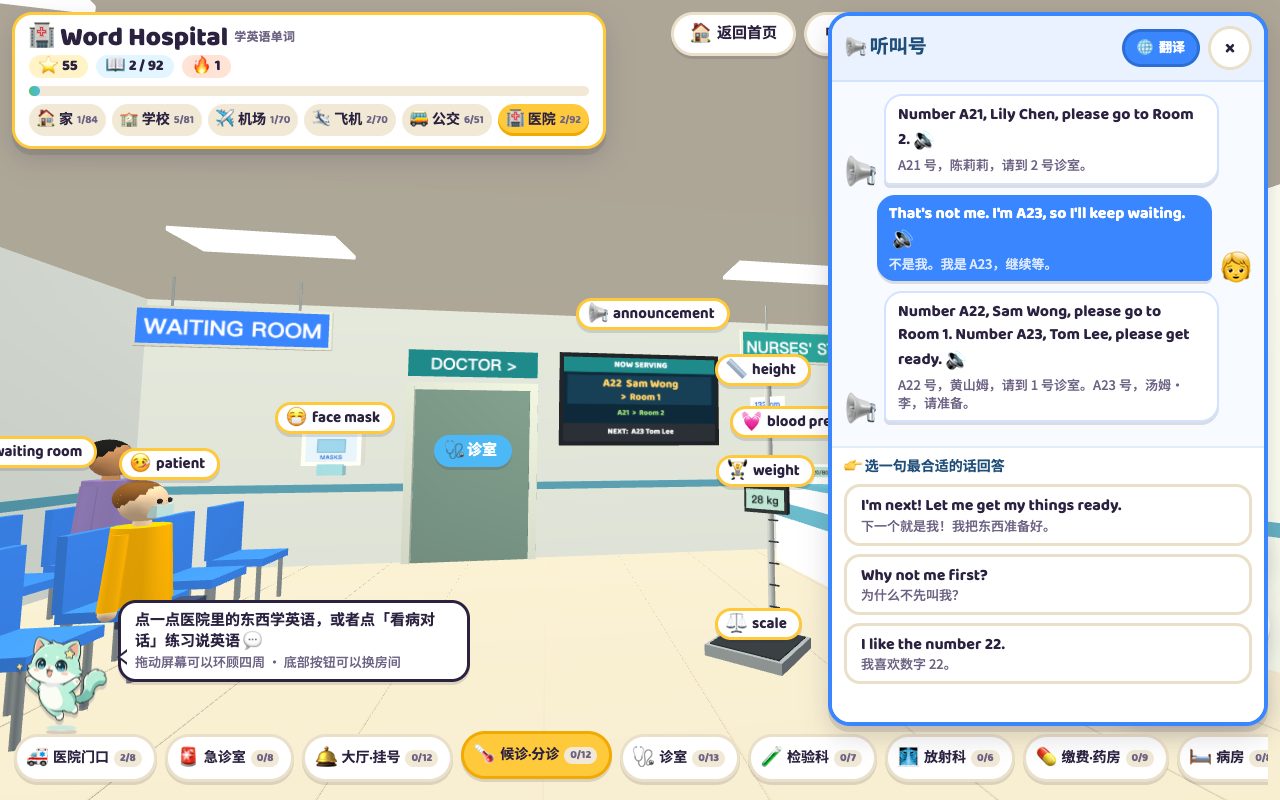
- Waiting for your number: the screen and the speaker call A21, A22, then A23. The child holds A23 and has to decide: not me, keep waiting; I'm next; that's me, go to Room 3. It feels very like a real waiting room.
- Telling the doctor: I have a sore throat and a bad cough. Asked how long, the answer is Since yesterday morning., followed by deep breaths and saying Ahh.
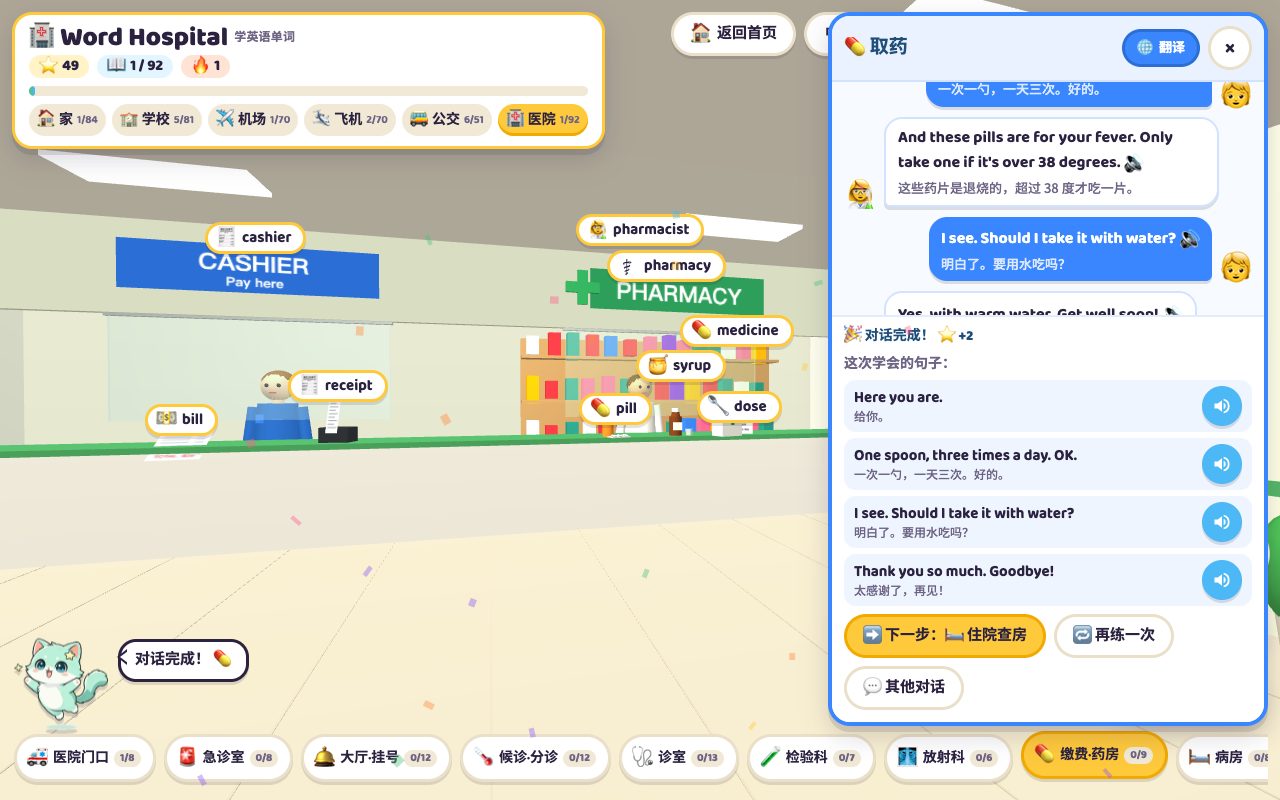
- Paying and medicine: Can I pay by card?, take the receipt to the pharmacy, and understand Take one spoon, three times a day. and the instruction to take a fever pill only above 38 degrees.
4. Emergencies and clinics: best never needed, vital when they are
Numbers 1 to 3 are emergencies: a fall from a bike with a sore wrist, and a cut finger that needs three stitches. The child learns My arm really hurts., It hurts here, near my wrist. and comforting lines like Can my mom hold my other hand? Numbers 18 to 21 cover the ward, a vaccine, the dentist and an eye test; the vaccine one ends with the child asking Can I have a sticker?, which makes my child laugh every time.
The ambulance word card carries a reminder that emergency numbers differ by country — 911 in the United States, 999 in the UK. Looking up the number for your destination before a trip matters more than knowing the word ambulance.
5. Two kinds of feedback for wrong answers
As on the plane, every step offers three replies and a wrong one does not reveal the answer. A rude choice, such as Just give me the medicine., asks for a politer way; an off-topic one, such as Is it raining?, asks the child to listen again. A first-try answer earns a star, and finishing a dialogue for the first time adds more.
The Hospital scene is English practice. The medical instructions in the dialogues are language examples, not medical advice; if a child is unwell, follow a local doctor's guidance.
6. How to fit it in
- Play numbers 4 to 17 using Next to walk through a full visit. It takes around 20 minutes, so spread it over two or three days.
- Repeat 10 to 12 until the child can say headache, stomachache, sore throat and rash in English.
- Play the emergency dialogues together at a calm moment, and talk about what to do if they ever get hurt.
The Hospital is the sixth scene in Word World; for how the other five work, see the Word World overview.
Frequently asked questions
How many words and dialogues are in the Hospital?
92 words in 10 areas and 21 dialogues numbered in the order of a visit, from emergency, check-in and waiting to the doctor, tests, paying and medicine, plus the ward, a vaccine, the dentist and an eye test.
Can the dialogues be played in a row?
Yes. Each one ends with a Next button that opens the following dialogue in the visit.
Can I rely on the medical instructions in the dialogues?
No. They are language examples for learning English, not medical advice. If a child is unwell, follow a local doctor.
What age is it for?
It is designed for ages 6–12, but the language for symptoms and a doctor's visit is just as useful for older children and adults.