
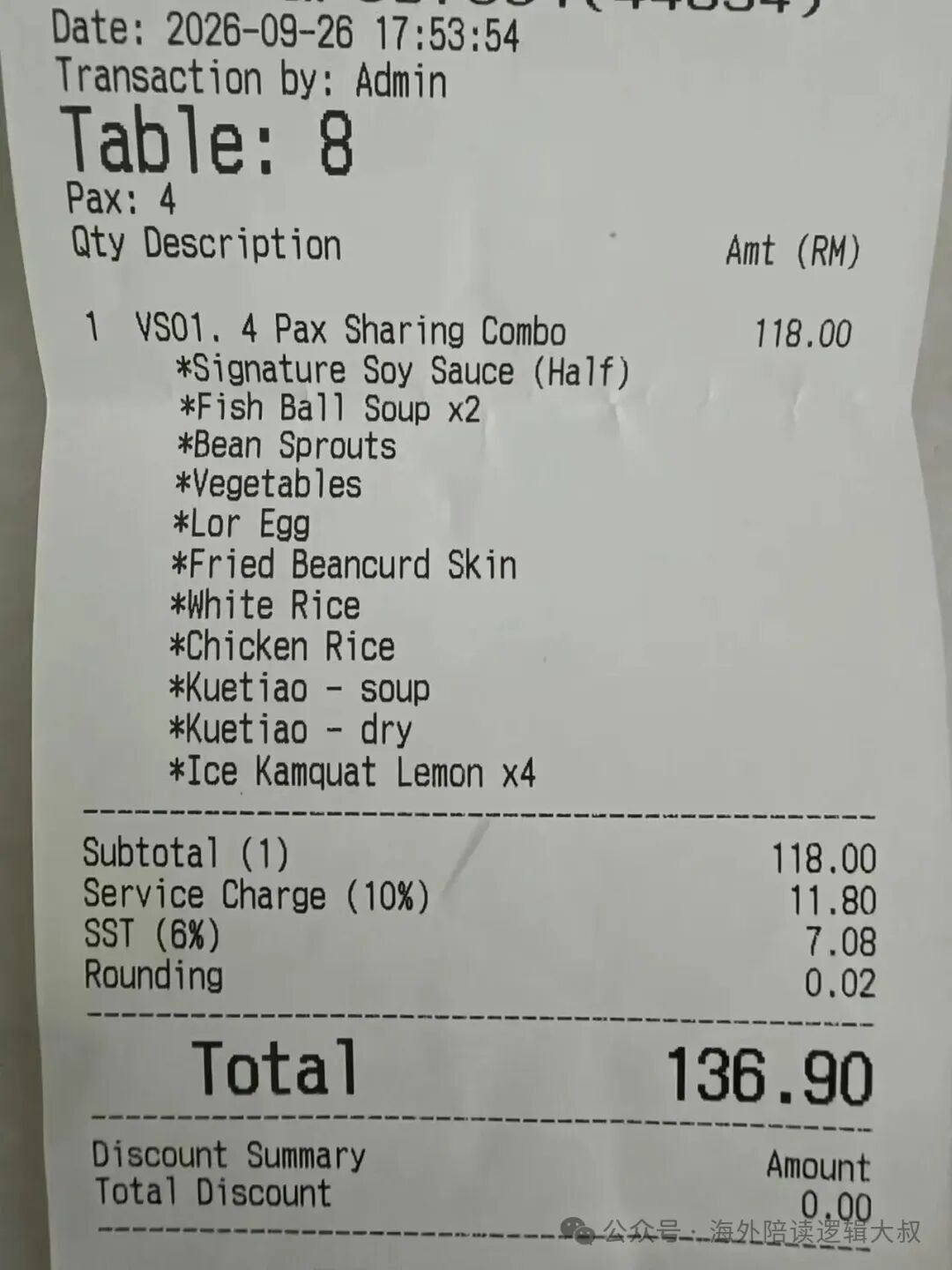
In Malaysian restaurants, tissue means a small packet you pay RM0.30 to RM0.50 for, takeaway is tapau, and reserving a table with a tissue packet is chop. A RM10 dish plus 10% service charge and 6% SST comes to about RM11.66, so ask about tax and service charge before ordering.
1. Why the English here sounds familiar but means something else
Sit down at a restaurant in Kuala Lumpur or Penang and the waiter asks what you want to drink. You say "water" and a RM2 bottle arrives. You ask for "tissue" and you get a small packet, with RM0.30 quietly added to the bill. You know every one of those words; their meaning has simply been redrawn locally.
The reason is not mysterious. English here has long been used alongside Malay, Hokkien, Cantonese and Tamil, forming a local spoken layer usually called Manglish. It works in two ways. One is borrowing: words like tapau, kosong and bungkus, taken from Malay or Chinese dialects, drop straight into English sentences. The other is narrowing or shifting the meaning of English words themselves: tissue stops meaning "paper tissue" and starts meaning "a small packet you pay for", while chop stops meaning "to cut" and starts meaning "to stamp" or "to reserve a seat".
For visitors and new long-stay residents, the real difficulty is rarely comprehension. It is that you understand the sentence, apply your own meaning, and then do the wrong thing or pay more than you expected. The situations below are the ones I kept running into while living in Malaysia.
2. Tissue: the most misread word in a restaurant
Start with the classic. In a Malaysian coffee shop (kopitiam) or hawker centre, tissue usually means one small packet of tissues, and it is chargeable, typically RM0.30 to RM0.50. It may be a packet of dry tissues or a wet tissue, placed on your table by the drinks server along with your drink, or brought over when you ask, and added to the bill at the end.
That is a long way from "restaurants provide tissues free". Plenty of hawker stalls genuinely do not offer free napkins; there may be a single roll on a stand shared by everyone, or nothing at all. So:
- If you want free napkins: ask "Excuse me, can I have some serviettes?" — though the likelier answer is "tissue satu" (one packet of tissue), followed by the chargeable packet.
- Carry your own: almost everyone living here keeps a packet in their bag. It is the simplest reliable fix.
- Wet tissues are billed separately: if a wrapped wet tissue is placed on your table and you have not opened it, you can usually hand it back and ask for it to be removed from the bill.
At a hawker centre or mamak stall, staff calling you "boss" or "tauke" (towkay, the boss), and addressing older women as "aunty" and older men as "uncle", is a friendly form of address with no edge to it. You can use "boss" for the stallholder in return; it is entirely natural here.
3. Tapau: better than "takeaway"
The everyday word for food to take away is tapau (from Cantonese, sometimes written tapao). From a mamak stall to a chain restaurant, "Tapau, please" is understood instantly and sounds far more local than takeaway. Bungkus comes from Malay, means the same thing, and is more common at Malay stalls and traditional shops.
Two details worth knowing:
- Drinks to take away often come in a plastic bag: at a mamak stall or hawker centre, tapau on a teh tarik or kopi may arrive as a clear plastic bag tied with a rubber band and a straw poked through. That is normal here, not laziness.
- Containers sometimes cost extra: some restaurants charge RM0.20 to RM0.50 per takeaway box, so it is fair to ask "Tapau, got extra charge?" when ordering.
There is also a habit difference: people here rarely wait until the end of a meal to ask for a doggy bag. They say tapau when ordering, and the kitchen packs it directly.
4. One packet of tissues, one whole table: the seat rule
In a hawker centre you will see empty tables marked with a packet of tissues, an umbrella, a water bottle, even a name card. These are not things someone forgot. They are reserved seats. The local verb is chop (also written chope), meaning "to claim the seat first". A RM0.30 packet of tissues is the cheapest and most standard reservation tool there is.
The unwritten rules are simple:
- If something is on the table, the table is taken: do not move someone else's tissue packet and sit down. This is one of the few things that visibly annoys people here.
- You can do the same: it is a widely accepted convention; there is no need to feel awkward about it.
- Sharing tables is normal: when it is busy, ask "Can share?" and you will usually get a nod.
Learn the second meaning of the same word as well: chop also means to stamp. A parking ticket has to be "chopped" at a machine or counter, a company seal is a company chop, and "need to chop" in an office means getting a stamp — never cutting.
5. Ordering drinks: kopi, kosong, peng and less sugar
The drinks menu in a local coffee shop is a language of its own, and the first look can leave you with no idea what to order. It is really built from modules: the type of coffee, whether sugar and milk are added or removed, and hot or iced. Learn the table below and breakfast becomes easy.
| What you say | What actually arrives |
|---|---|
| Kopi | Coffee with condensed milk, on the sweet side |
| Kopi O | Black coffee with sugar (O from Hokkien for "black") |
| Kopi C | Coffee with evaporated milk and sugar |
| Kopi O Kosong | Black coffee, no sugar |
| Kosong | "Zero" — no sugar or no milk, depending on the drink |
| Peng / Ais | Iced (peng from Hokkien for ice, ais from English "ice") |
| Teh tarik | Pulled milk tea: black tea with condensed milk, frothy |
| Kurang manis | Less sweet (Malay) — the single most useful phrase |
| Bungkus / tapau | To take away |
A local coffee is usually RM2 to RM3.50, a little more if iced. Milo is the national drink, and a Milo dinosaur is iced Milo topped with a thick layer of Milo powder, RM4 to RM6 — worth trying once, not an everyday habit.
If you would rather not study the vocabulary, the safest single order is: "Kopi, kurang manis, peng." Coffee, less sweet, iced. A few repetitions and it feels natural.
6. From menu price to bill: where the extra money goes
The menu says RM10 and the bill says RM11.60 or more. This is where many people are caught out in their first Malaysian restaurant. The gap usually comes from three things:
- Service charge: restaurants commonly add 10%.
- Sales and Service Tax (SST): usually 6% for food and beverage, calculated after the service charge.
- Table items: wet tissues, peanuts and pickles, from RM0.50 to RM2 each, sometimes placed on the table by default.
So a RM10 main course with 10% service charge and 6% tax comes to about RM11.66. Add a RM1 wet tissue and a RM2 side dish and the bill approaches RM14.70 — nearly 50% above the menu price. Hawker centres and mamak stalls normally charge neither service charge nor tax, which is why eating out can vary so widely in price.
"Is service charge included?", "Is this before tax?", and "No wet tissue, thank you." Three short questions head off most bill surprises.
7. Small words, big effect: already, got, can, one, lah
Beyond vocabulary, local grammar habits make sentences sound slightly different from the English you learned. The words below are used constantly, and understanding them smooths a lot of conversations.
- already = done: "Paid already" means it has been paid. "Finish already" means the food is finished. It sits at the end of the sentence to mark completion.
- got = there is / do you have: "Got table?" means is there a table. "Got charge or not?" means is there a charge. In questions it can replace "there is" or "do you have" almost anywhere.
- can / cannot = yes, that works / no: often a complete sentence on its own. "Can?", "Can, can." and "Cannot." are all full answers.
- one = emphasis: "This one nicer one" means this one is nicer. The "one" is not counting anything; it is a tone marker.
- lah, lor, meh, mah: sentence-final particles for emphasis, resignation or disbelief. You do not need to decode them; the main clause still makes sense without them.
- where got = no way: expresses disbelief or contradiction. "Where got expensive?" means it is not expensive at all.
- is it? = right?: a tag at the end of a statement. "You staying here, is it?" means you are staying here, right?
A few ordinary English words also have fixed local pairings worth knowing: handphone (a mobile phone, rarely "mobile"), aircon (air conditioning), follow (to come along, "You follow us?"), fetch (to pick someone up, "I fetch you at 6"), send (to drive someone home), last time (previously, "Last time I stayed in KL"), and open / close for switching appliances on and off, as in "open the light".
8. A reply sheet for visitors
The good news: nobody expects you to speak Manglish. Standard English works everywhere in Malaysia. Swap a handful of keywords and communication gets much easier. The table below is organised by situation.
| Situation | What you might say | What works better here |
|---|---|---|
| Takeaway | Takeaway, please | Tapau, please / Bungkus |
| No sugar | No sugar | Kosong |
| Less sweet | Less sweet | Kurang manis |
| Iced | Iced | Peng / Ais |
| Is there a table? | Is there a table? | Got table? |
| Is this chargeable? | Do you charge for this? | Got charge or not? |
| Already paid | I have already paid | Paid already |
| May I sit here? | May I sit here? | Can share? |
| Not spicy | Not spicy | Tak pedas (Malay) |
Three practical notes to finish. First, ask about tax and service charge before you order, especially in places that look smart. Second, keep a packet of tissues in your bag; it solves both the missing free napkins and the reserved seat in one go. Third, just listen to the particles rather than forcing them — using them wrongly is more awkward than not using them at all.
Once these few words come naturally, eating out suddenly gets easier. If you want to plan your daily spending more precisely, start with Cost of Living in Penang: A Real Monthly Budget. And because most hawker stalls and small shops now take QR payments, the practical details are in Touch n Go eWallet: A Practical Guide.
Frequently asked questions
Why do I get charged for tissue in a Malaysian restaurant?
Because tissue here usually means one small packet of tissues sold as an item, around RM0.30 to RM0.50, brought with your drink and added to the bill. If you want a free napkin, ask for serviettes, but many stalls genuinely do not provide them — carrying your own packet is the simplest fix.
How do I ask for takeaway?
Say tapau. It is understood everywhere from mamak stalls to chain restaurants and sounds more local than takeaway. Bungkus, from Malay, means the same and is more common at Malay stalls. Note that drinks often come in a plastic bag, and some restaurants charge RM0.20 to RM0.50 for a takeaway box.
Is the packet of tissues on the table something someone left behind?
No, it is a reserved-seat marker, known locally as chop (or chope). Tissues, an umbrella or a water bottle on a table mean the table is taken, so do not move them and sit down. You can reserve a seat the same way, and when it is busy, asking Can share? usually gets a yes.
Why is the bill so much higher than the menu price?
Three things: a 10% service charge, Sales and Service Tax (SST) usually at 6%, and table items such as wet tissues and peanuts at RM0.50 to RM2 each. Hawker centres and mamak stalls normally charge neither service charge nor tax, so the same meal can cost very different amounts.